How to Plan a New Mexico Mule Deer Hunt: Draws, Hunt Codes, Access and Costs
Draw-choice order, application payments and access guidance checked September 11, 2026. The 2026–27 public draw deadline has passed. Use this season’s rules for current hunts and recheck the next published application cycle rather than assuming the dates repeat.
New Mexico rewards careful selection of three usable hunt choices, not years spent buying preference points. For a mule-deer-only trip, every choice must also fit the legal deer, available land, sporting arm and dates. A famous unit, a private-land offer and a public draw license can represent very different hunts.
Research disclosure: Big Game Ledger has not hunted New Mexico. This guide is assembled from current agency regulations, application materials, maps and access resources. Official rules control whenever they differ from this article.
New Mexico mule deer planning at a glance
- The 2026–27 deer draw deadline was March 18 at 5 p.m. Mountain Daylight Time; results were scheduled for April 22.
- New Mexico uses hunt codes and a random drawing rather than a preference-point queue.
- Mandatory deer harvest reporting can affect eligibility for the next draw.
- Species accuracy: verify that the hunt is explicitly valid for mule deer rather than assuming every deer license covers the same species.
Start with the exact hunt, not a reputation
Write down the official hunt code or license name before comparing units. Record the legal deer, dates, weapon, boundary, quota and access notes on one line. A famous unit with the wrong season or unreachable land is not a usable plan.
| Planning layer | Question to answer |
|---|---|
| License | Is it general, limited, controlled, guided, landowner or leftover? |
| Species | Does the hunt cover mule deer, another deer species or either? |
| Season | What are the legal dates, weapon and animal restrictions? |
| Access | Can the intended public land be reached legally under current road rules? |
| Recovery | Can meat be cooled and removed from the hardest realistic location? |
How New Mexico evaluates your first three choices
New Mexico randomly orders applications, then checks an application’s first, second and third choices before moving to the next application. It does not award preference for unsuccessful prior years. The allocation framework is at least 84% resident, 10% outfitted resident/nonresident and 6% nonresident without an outfitter contract, subject to the actual draw rules. Six percent is a license allocation, not your personal chance of success. Source: New Mexico’s draw explanation and odds reports.
Build three hunts you would actually accept
Illustrative planning exercise—not a prediction of draw odds: call your favorite hunt A, your second preference B and your third C. Before entering them, make a separate trip sheet for each. A may require a remote camp; B may fit a road-based hunt; C may fall on dates when your recovery partner cannot travel. If C is not workable, it is not a good fallback simply because its historical applicant count is lower.
Rank the choices in your genuine order of preference. Compare the same hunt code and applicant pool in the agency’s report, then check current quotas and eligibility. Do not compare an outfitted pool’s results to an unguided application or add three published percentages as if the outcomes were independent.
The fourth choice is not another hand-picked hunt code
For deer, the optional fourth-choice process distributes remaining licenses after the main application choices have been examined. The agency warns that applicants must be willing to accept a hunt in the selected quadrant; the sporting arm follows the first choice. See the fourth-choice explanation. Do not select it expecting one specific unit or the same access conditions as your first three choices.
Our recommendation: if your travel dates, physical limits or mule-deer objective leave little flexibility, investigate every possible consequence before adding that option. More ways to receive a license do not necessarily produce a hunt you can use.
Written permission must match the actual property
New Mexico’s hunting lands and maps page provides a written-permission form and explains the requirement to obtain permission before hunting private property. A state license does not grant blanket entry to private or tribal land.
For a private-land proposal, request the exact parcel map, authorized hunters, dates, vehicle access and recovery arrangements before paying for services. Confirm the applicable license route with the agency; do not assume a landowner’s verbal invitation replaces the necessary license or that a private-land-only license covers adjoining public ground. For a public-land draw hunt, trace a legal route all the way from the road to the intended parcel. Land ownership colors without a legal entry route are not a finished access plan.
Terrain, maps and legal access
New Mexico units combine public, tribal and private land across mountains, mesas and desert. Verify the hunt code, unit boundary, land status, access permission, road condition and E-Tag or carcass-tag method.
Start with the official hunt-planning or mapping resource, then cross-check federal travel maps, county road status and current fire or emergency closures. Offline maps help in the field but do not replace legal boundary descriptions.
Costs and field logistics
The agency’s application instructions say online draw applicants pay the application fee and full license fee when applying. Budget for the amount charged now, not only the amount you expect to lose if unsuccessful; check refund terms and timing separately. There is no preference-point purchase in this draw. Add the required qualifying license and applicable stamps, then price access, travel, camp, recovery and meat care for each of your three choices. Keep outfitter or land-access deposits separate from state fees and record their cancellation terms in writing.
Buck expectations and hunt quality
Big country and mature bucks create the appeal, but there is no defensible statewide “average buck size.” Age structure, winter survival, precipitation, migration, pressure and season timing vary sharply. Compare several years of unit-level harvest and age data without turning them into a promise.
Hunter education, CWD and field compliance
Before travel, verify hunter-education eligibility, tagging or E-Tag procedures, evidence-of-sex rules, mandatory reporting, chronic wasting disease sampling and carcass-transport restrictions. Check every state through which meat or parts will travel.
A practical New Mexico planning sequence
- Choose hunt style, weapon and total budget.
- Record exact hunt codes and legal species.
- Compare current rules, draw history and quotas.
- Prove legal access and road continuity.
- Plan glassing, water, camp, recovery and meat care.
- Apply through the current agency system and save confirmation.
- Recheck closures, weather, CWD and tagging before travel.
Official New Mexico mule deer planning links
Return to the Mule Deer Hunting hub, browse Hunt Planning, or compare supporting Maps & Apps.
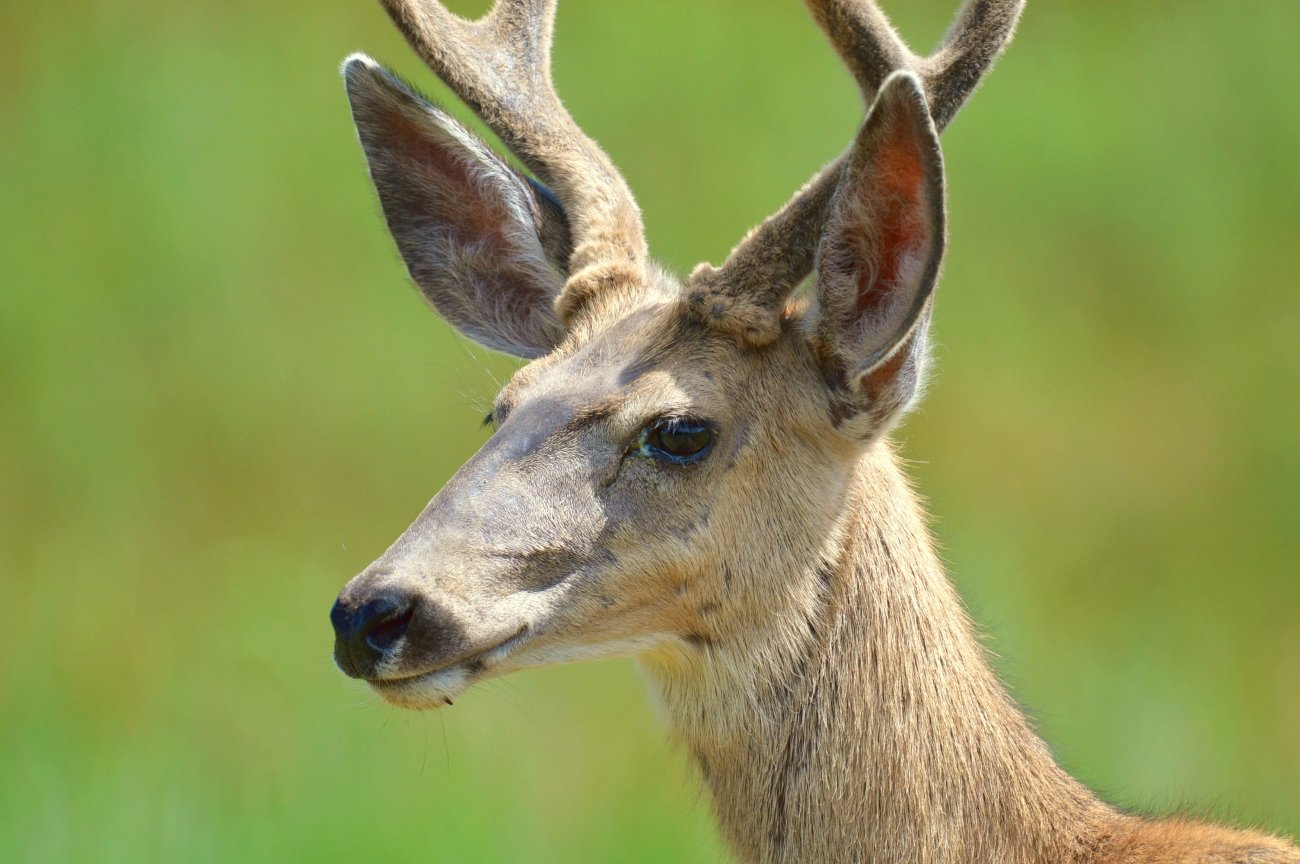
Featured photo: Representative mule deer portrait, photographed at Rocky Flats National Wildlife Refuge, Colorado—not in New Mexico. Ryan Moehring / USFWS; public domain.