What a Mule Deer Hunt Actually Involves: A Beginner’s Planning Guide
Reviewed: August 15, 2026. This is a general planning framework, not a substitute for the current regulations, hunt-specific maps or wildlife-agency instructions for the state and unit you choose.
A mule deer hunt is rarely one continuous stalk toward a visible buck. More often it is a chain of decisions: choosing a legal hunt, learning the unit, reaching glassing country before daylight, searching huge amounts of terrain, judging wind and cover, making a careful approach, deciding whether a shot is ethical, and having a recovery and meat-care plan ready before anything happens.
That combination of research, patience and western terrain is what makes the hunt exciting. It is also why a first mule deer trip should be planned as a complete system rather than a tag plus a gear list.
Research disclosure: Big Game Ledger has not hunted mule deer and does not present this guide as firsthand field experience. It synthesizes current wildlife-agency guidance, public-land planning resources and migration research. Official regulations and qualified local instruction control.
Use the printable planning checklist
Track regulation sources, applications, access, maps, budget, field systems and backup decisions in one six-page workbook.
First, know what a mule deer is
Mule deer (Odocoileus hemionus) are western deer recognized by large ears, a narrow rope-like tail with a dark tip, a bounding gait and antlers that typically fork rather than growing from one main beam. The West also holds white-tailed deer, including Coues white-tailed deer in the Southwest. A deer license may cover one species, both species or a particular legal animal. Identification is part of hunt planning, not an afterthought.
The Colorado Parks and Wildlife mule deer profile describes mule deer as animals of western edge habitats whose populations respond to weather, habitat quality, disease, development and other pressures. Those differences are one reason a statewide “average buck size” is not useful planning information.
The main mule deer hunt formats
| Format | What the day often involves | Primary planning challenge |
|---|---|---|
| Spot and stalk | Glass from distance, locate a deer, study its route and use terrain and wind to approach. | Optics discipline, patience and a realistic stalk route. |
| Still-hunting timber or cover | Move slowly through likely bedding or transition habitat while watching small openings. | Wind, noise and seeing the deer before it detects movement. |
| Ambush or travel-route hunting | Watch a proven trail, saddle, feeding edge or water approach. | Current sign, legal access and avoiding excessive disturbance. |
| Migration or late-season hunting | Search winter range, transition country or weather-driven movement. | Current closures, road conditions, changing distribution and cold-weather recovery. |
Real hunts may combine several formats. A hunter might glass at dawn, still-hunt shaded cover at midday and return to a feeding edge before dark. The legal season, weapon, weather, terrain and deer behavior determine which method makes sense.
What glassing actually means
Glassing is not simply looking across a valley. It is a repeatable search process. Start with the nearest cover, scan obvious openings, then divide distant terrain into small sections. Look for an ear, leg, antler tip, horizontal back line or color that does not match the vegetation. Change the viewing angle when brush or topography hides part of the slope.
- Reach the first observation point before the period of expected movement.
- Set up where the sun, wind and skyline do not expose the hunter.
- Use binoculars for broad searching and a spotting scope only when extra detail is useful.
- Mark deer, landmarks and approach routes on an offline map.
- Watch long enough to learn where a deer beds or travels before starting a stalk.
Optics do not replace field judgment. Heat shimmer, distance, poor angles and movement can make identification uncertain. If the legal animal cannot be confirmed, the hunt has not produced a shot opportunity.
A typical day in mule deer country
A common public-land plan begins well before daylight. The hunter travels to a glassing point using a route that avoids the country being watched. Dawn may produce a short window of feeding or travel. Once a deer beds, the next several hours may be spent confirming the location, checking wind, studying terrain and deciding whether a stalk is possible.
Midday is not automatically dead time. It can be used to glass shaded bedding cover, confirm roads and access, relocate after a wind change, rest, filter water or prepare for the evening movement. Late afternoon returns attention to feeding edges, saddles, burns, basins or open slopes. The day ends with enough light and energy reserved for navigation and recovery—not merely enough time to reach a shooting position.
Licensing comes before unit research
Western states use different systems: general licenses, regional licenses, limited quotas, controlled hunts, bonus points, preference points, landowner permits, guided pools and leftover sales. Begin with the current agency booklet and write down the exact hunt code, species, unit, dates, weapon and legal animal.
The Mule Deer Hunting hub links to current planning guides for Colorado, Wyoming, Montana, Idaho, Arizona, New Mexico, Nevada and Utah. Historical draw odds describe previous demand and quotas; they do not guarantee a future license.
Map legal access, not just public land
A public parcel is not usable if the approach crosses private land without permission, the connecting road is closed, or the vehicle route violates the current travel plan. Check agency unit maps, land ownership, federal motor-vehicle use maps, county road status, seasonal gates, wilderness boundaries, fire closures and any separate access permit.
The USGS Western Migrations map shows why seasonal range matters: state and Tribal collar data document migration routes, stopovers and winter ranges for western ungulates. It is a research and conservation tool, not a promise that deer will occupy a specific location during a hunt.
Physical preparation is terrain-specific
Train for the actual unit rather than an abstract “western hunt.” Steep mountain terrain requires climbing and downhill control. Desert hunts add heat and water management. High elevation adds acclimatization concerns. Broken badlands demand repeated short climbs and careful footing.
- Build steady aerobic capacity and time on feet.
- Practice climbing and descending with a gradually loaded pack.
- Break in the exact boots and sock system before travel.
- Carry and filter water using the field equipment selected for the hunt.
- Practice navigation, layering and emergency shelter in poor weather.
The shot is only the midpoint
A shot should be attempted only when the deer is legal, the background is safe, the distance and angle are within demonstrated ability, and recovery is realistic. Hunters must follow the applicable firearm or archery equipment rules and should practice from field positions rather than relying only on a bench-rest group.
After the shot, mark the deer’s last location and the hunter’s shooting position. Observe the reaction, wait as conditions require, and approach methodically. If the deer moves out of sight, avoid turning the search into an unplanned rush that destroys sign or creates unsafe movement.
Recovery and meat care must be planned in advance
Before hunting a distant slope, know the legal tagging procedure, evidence-of-sex requirement, carcass rules and whether chronic wasting disease testing or transport restrictions apply. Carry the tools and game bags needed for the approved field method, and know how the meat will reach refrigeration.
Warm weather, a long climb and darkness can turn a successful shot into a recovery emergency. Estimate pack weight, number of trips, water needs, route hazards and cooling time before choosing where to hunt. Commercial pack-out help should be verified before the season rather than assumed available after a harvest.
What a mule deer hunt costs
The tag is only one line in the budget. Add the qualifying license, application or point fees, habitat stamps, travel, lodging or camp, mapping, fuel, food, optics, weapon practice, clothing, water treatment, meat cooling, pack-out help, processing, taxidermy and an emergency margin. Prices change, so obtain current amounts from the state agency and actual vendors before committing.
A beginner’s mule deer timeline
- Six to twelve months out: choose states, study draw systems, establish the budget and complete hunter education.
- Before the deadline: select exact hunt codes, verify the license prerequisites and submit early.
- After drawing: learn boundaries, access, travel rules, terrain and likely recovery routes.
- Eight to twelve weeks out: increase terrain-specific conditioning and field-position practice.
- Two weeks out: recheck closures, fire, weather, CWD, tagging and road conditions.
- Before each field day: confirm wind, water, communications, sunset, navigation and the recovery plan.
Beginner checklist
- Exact license, hunt code and legal species confirmed
- Unit boundary and legal access downloaded offline
- Weapon and field-position practice completed
- Water, weather and emergency communication planned
- Tagging, evidence-of-sex and CWD rules saved
- Recovery route, game bags and refrigeration arranged
- Budget includes travel, meat care and contingency
Continue building the plan
Choose a state through the Mule Deer Hunting hub, then use Maps & Apps, Hunt Planning and Gear to build the supporting systems.
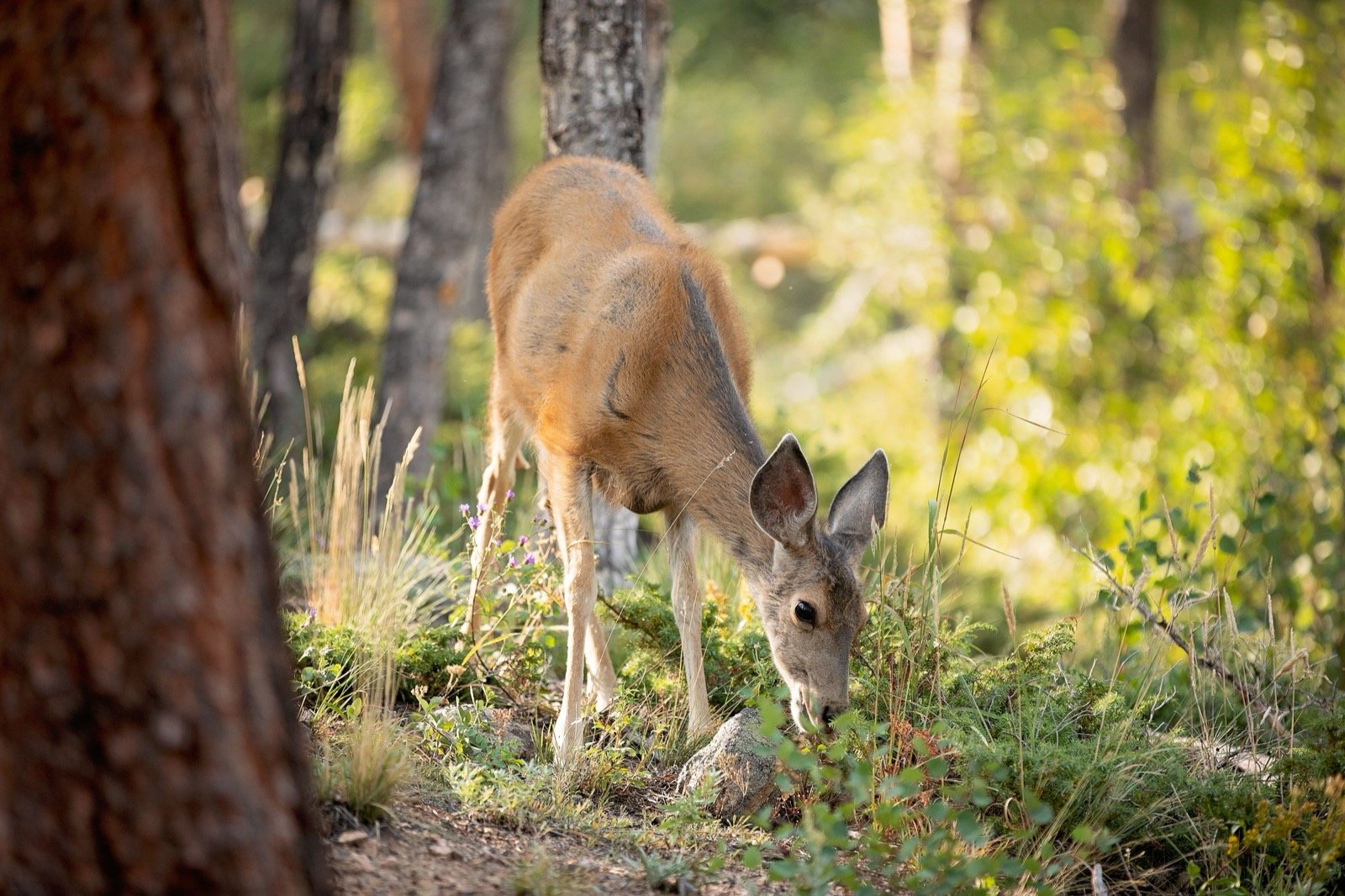
Featured image: mule deer photographed by Sherry Baze in Rocky Mountain National Park, Colorado, via Pexels. Newly assigned to this article and not reused elsewhere on Big Game Ledger.
Continue with a state mule deer guide
State systems use different hunt-unit terms, license structures, draw rules and access resources. Continue through the Mule Deer Hunting hub or open the guide for the state being considered: