How to Plan a New Mexico Elk Hunt: Draws, Hunt Codes, EPLUS and Costs
Reviewed for New Mexico’s 2026–27 license year: August 24, 2026. Hunt codes, quotas, access, landowner authorizations and fees can change. Confirm the current rules with the New Mexico Department of Wildlife before applying, purchasing or traveling.
New Mexico elk hunting can combine high desert, volcanic mesas, mountain timber, monsoon-grown grass and bugling bulls. The opportunity is split between a public draw and private-land routes, and the vocabulary matters. A draw license, an EPLUS authorization and a private-land elk license are different things.
Research disclosure: Big Game Ledger has not hunted New Mexico. This guide is assembled from the current 2026–27 rules, draw instructions, EPLUS materials, harvest-reporting information and agency maps. Official rules control whenever they differ from this article.
New Mexico elk planning at a glance
- Species focus: Rocky Mountain elk.
- 2026 public-draw deadline: March 18, 2026 at 5 p.m. Mountain Daylight Time.
- Results: big-game draw results were scheduled for April 22, 2026.
- No preference points: New Mexico’s draw does not build a traditional point queue.
- Allocation: state law directs the draw to attempt at least 84 percent of licenses to resident applicants, 10 percent to applicants using a contracted outfitter and 6 percent to nonresidents without a contracted outfitter.
- Private land: EPLUS creates separate authorization and license routes. An authorization is not itself an elk license.
Public draw: choose hunt codes carefully
New Mexico applications use hunt codes that combine unit, dates, weapon, legal elk and quality classification. Applicants can list up to three choices considered in the main drawing, and may designate a fourth choice for a second distribution of remaining deer or elk licenses. Read the full hunt-code line before comparing odds.
The draw is random rather than preference-point based. Historical draw reports help measure demand but do not move an applicant toward a guaranteed tag. Compare the resident, outfitter and nonresident pools that actually apply to the planned application.
| Route | What it provides | Critical check |
|---|---|---|
| Public draw | A license tied to a hunt code if successful. | Unit, dates, weapon, legal elk and reporting eligibility. |
| Outfitter pool | Separate allocation for applicants with a qualifying contracted outfitter. | Current contract and registration requirements. |
| EPLUS authorization | A landowner-issued authorization number and hunt code. | Whether it is unit-wide or ranch-only and what access is included. |
| Private-land elk license | The actual license purchased after obtaining the required authorization or ranch code. | Do not mistake the authorization price or agreement for the state license. |
Understand EPLUS before paying anyone
The Elk Private Lands Use System distributes some elk opportunity through participating landowners. In the Primary and Special Management Zones, a hunter generally needs an authorization number and hunt code before purchasing the corresponding private-land elk license. Secondary Zone procedures differ and may use ranch codes.
An authorization can be unit-wide or ranch-only. Unit-wide does not mean unrestricted private access; the hunter still needs lawful permission for private property and must understand the unit-wide rules. Ranch-only opportunity is limited to the enrolled ranch. Put every promise in writing, verify the authorization with the Department and document whether lodging, guiding, trespass access or retrieval help is included.
2026–27 license fees and cash flow
The 2026–27 rules list nonresident standard mature-bull or either-sex elk draw licenses at $773 and quality or high-demand licenses at $998. Draw license fees include a nonrefundable $13 nonresident application charge. Applicants are charged the application fee and full license fee when applying, subject to the Department’s current refund process for unsuccessful applications.
Those figures are not the total trip cost. Add the qualifying game-hunting license, habitat stamps or validations when applicable, travel, lodging or camp, mapping, fuel, water, meat cooling, pack-out help, taxidermy, outfitter expense and any separately negotiated EPLUS authorization or private access.
Harvest reports can control eligibility
New Mexico requires harvest reports from elk license holders even if they did not hunt or harvest. For eligibility in the 2026–27 draw, the elk-report deadline matched the March 18 draw deadline; reports after February 15 carried an $8 late fee. Save the confirmation number. A missed report can reject the next application.
Terrain, access and the New Mexico adventure
New Mexico elk country stretches from northern mountain basins and ponderosa timber to open mesas, burn scars and dry grasslands. Water, road condition, monsoon damage, wildfire closure and private-land boundaries can matter as much as elevation. Verify Bureau of Land Management and Forest Service motor-vehicle rules plus the current Department unit map.
The adventure is built around big skies, bugles moving through timber and the challenge of finding elk across broken country. Do not promise a statewide “average bull.” Age structure, habitat, precipitation, hunt classification and pressure vary by unit and season. Use harvest and draw reports for context only.
Build equipment around your New Mexico hunt plan
Define your access route, camp arrangements, water plan and recovery logistics before choosing equipment. Use the western big-game hunting gear checklist to organize what you already own and identify what still needs testing.
- Water planning: Our backcountry water-treatment guide covers treatment options, carrying capacity and backup planning. Treat water supply and treatment as separate decisions.
- Glassing: Our hunting binocular guide helps compare field of view, magnification and carried weight for your planned observation distances.
- Recovery: Our big-game meat-care kit guide helps organize equipment for recovery, cooling and transport alongside the current rules for your hunt and route home.
These are research-led equipment resources, not claims that we have field-tested gear in New Mexico. For a guided hunt, ask what equipment and recovery services are included before buying duplicates.
Hunter education, tagging and CWD
All hunters younger than 18 need a New Mexico or recognized out-of-state hunter education number, or a valid Mentor Youth number where allowed, before purchasing the required game-hunting license. Check age and mentorship limits in the current booklet.
Confirm whether the hunt will use E-Tag or a physical carcass tag, and understand validation, evidence-of-sex and possession rules before entering the field. Review current CWD sampling, carcass transport and disposal guidance for the harvest unit and every state on the route home.
A practical New Mexico planning sequence
- Confirm harvest-report eligibility and create the customer account.
- Choose public draw, outfitter pool or private-land route.
- Record exact hunt codes and legal elk.
- Compare draw reports for the correct applicant pool.
- Audit unit boundary, roads, public land, water and closures.
- For EPLUS, verify authorization type and access in writing.
- Build recovery, cooling and emergency plans for dry, remote country.
- Recheck rules, tagging, CWD and fire conditions before travel.
Frequently asked questions
How does the New Mexico elk draw work?
The public draw is organized by exact hunt codes rather than a general statewide elk application. Review the current NMDGF draw explanation, eligibility rules and application deadlines before choosing codes.
What is a New Mexico elk hunt code?
A hunt code identifies the species, legal animal, weapon, game management unit and season. Match every code to the current rules and map instead of relying on an old unit summary.
What is EPLUS?
EPLUS is New Mexico’s system for certain private-land elk authorizations. Landowner authorization, license purchase and property access are separate issues; verify all three through the official NMDGF EPLUS resources before paying anyone.
Where can I find a map for New Mexico elk Unit 12 or another GMU?
Use the Department’s official game-management-unit maps and EPLUS maps and resources, then confirm the boundary, land status and access route for the exact hunt code. A unit map does not itself grant access to private land.
What costs are charged when applying for New Mexico elk?
New Mexico may require applicants to front license costs, while refund treatment and nonrefundable charges depend on current rules. Confirm the live application instructions and build travel, lodging, meat care and contingency costs with our guided elk hunt cost guide.
Official New Mexico elk planning links
- Big-game applications and draw information
- 2026–27 Hunting Rules and Information
- How the New Mexico draw works
- EPLUS private-land elk information
- Harvest reporting
- Official game-management-unit maps
- Current publications and elk materials
Return to the Elk Hunting hub or compare the Arizona elk guide and Wyoming elk guide.
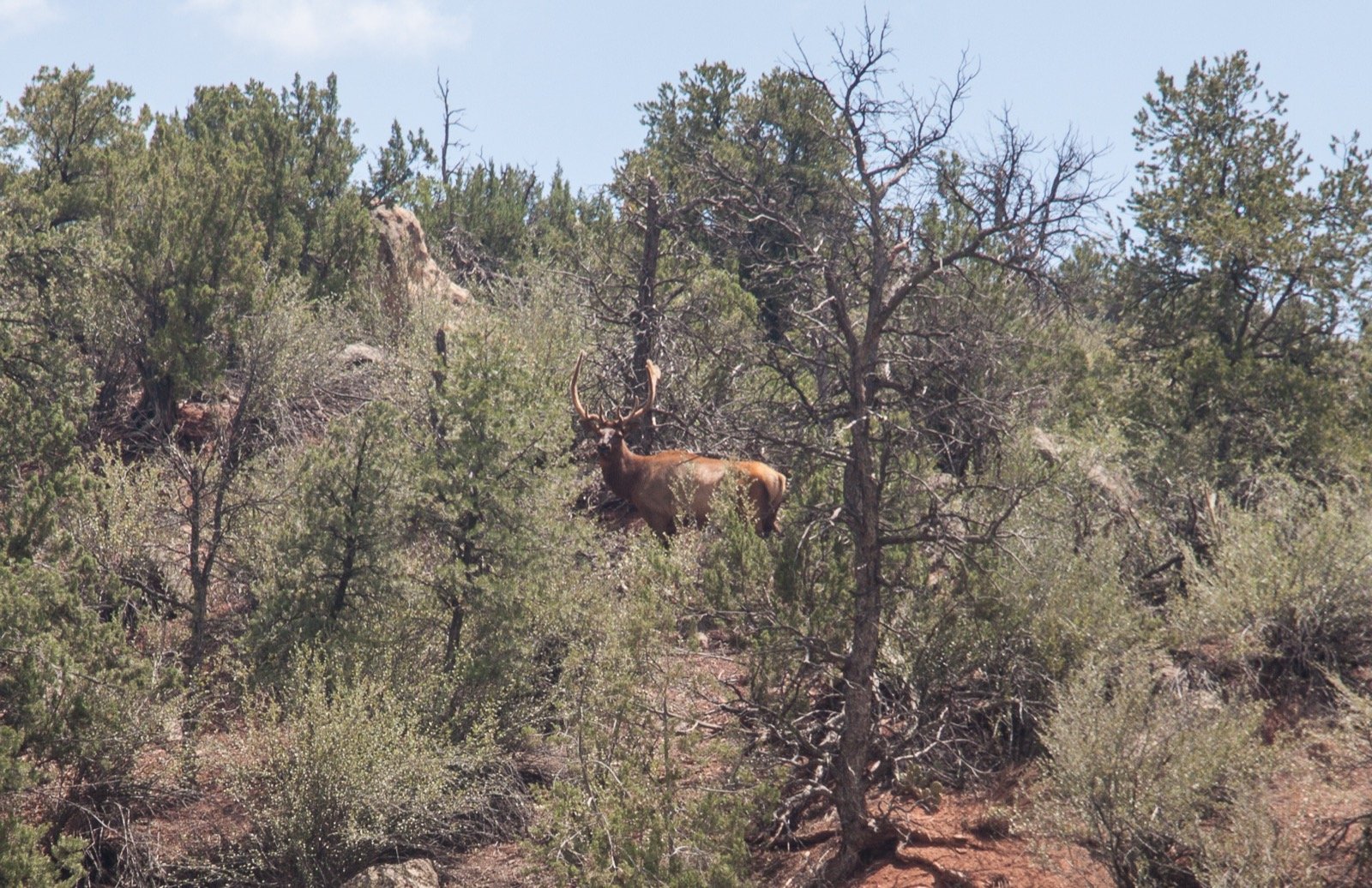
Featured image: a bull elk in the Jemez Mountains of New Mexico, photographed by mnchilemom. Licensed CC BY 2.0 via Wikimedia Commons and not reused on another Big Game Ledger page.