Alaska Moose Hunt Planning Guide (2026–2027)
Last reviewed: August 24, 2026 for the 2026–2027 regulatory year. Emergency orders, permit conditions and unit rules can change. Verify the exact hunt with Alaska Department of Fish and Game before acting.
Editorial note: This is a research-based Alaska moose planning guide, not a firsthand hunt report. It does not promise access, animal size or hunting success.
Alaska offers North America’s broadest and most complex moose-hunting landscape. Opportunity ranges from general-season harvest-ticket hunts to registration, drawing, Tier II and community subsistence structures. The correct plan starts with the Game Management Unit and hunt type—not with an outfitter advertisement or a photograph of a large bull.
Alaska moose hunt at a glance
| Regulatory year | July 1, 2026–June 30, 2027 |
|---|---|
| Permit structures | General season, registration, drawing, Tier II and other hunt-specific pathways |
| Nonresident requirement | Complete the ADF&G Nonresident Moose Hunter Orientation and carry proof in the field |
| Central risk | Misidentifying a legal bull or underestimating transport, meat-on-bone rules and recovery distance |
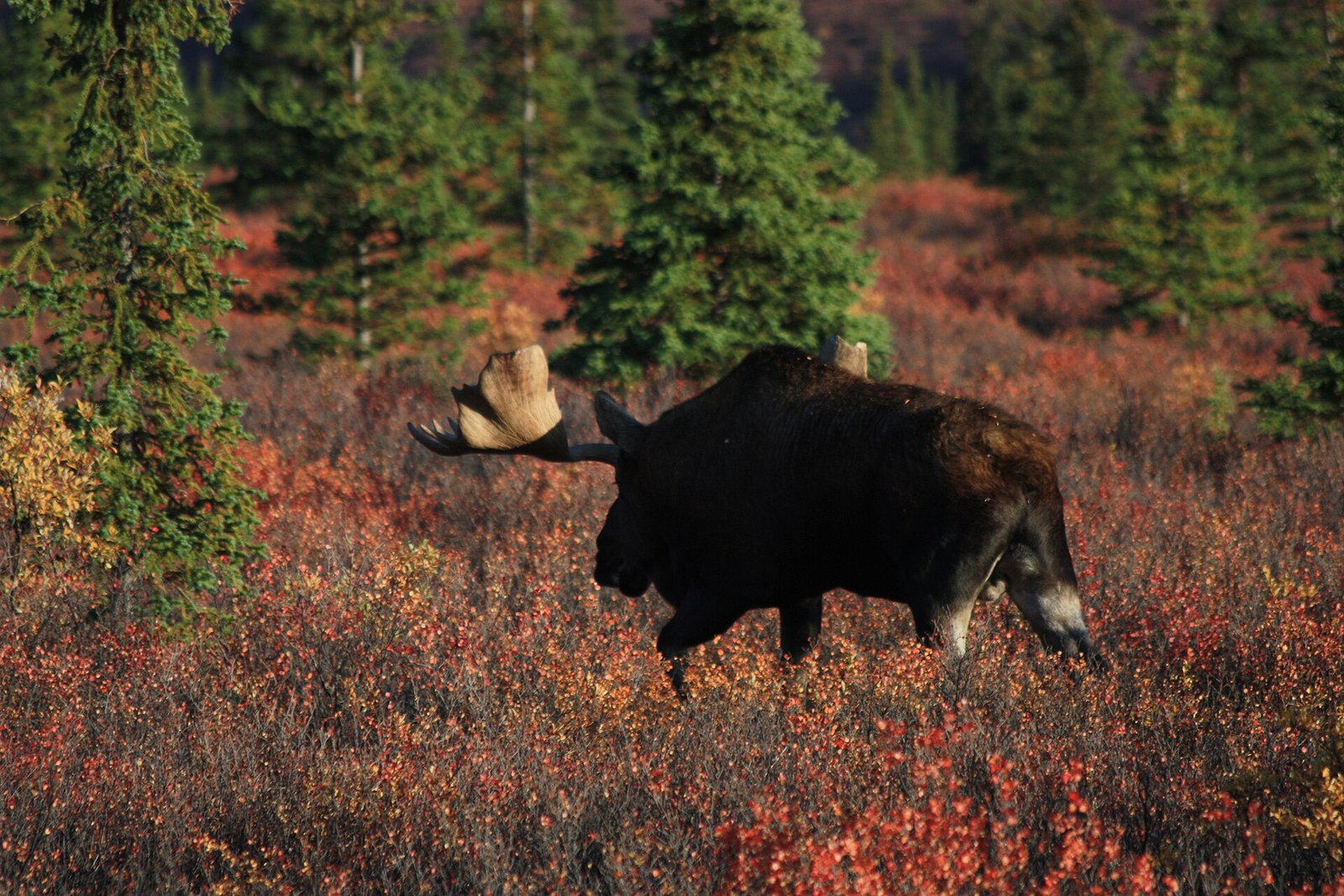
Bull moose in Denali. Photo: Robbie Hannawacker/NPS, public domain.
Start with the 2026–2027 regulations
Alaska regulations are organized by GMU and subunit. Two neighboring areas can have different dates, resident restrictions, antler definitions, permit types, motorized-access rules and reporting deadlines. Open the current regulations and the official hunt-opportunity database together. Save the exact unit, hunt number if applicable, legal animal, season, permit availability and reporting instructions.
General-season hunts normally require a harvest ticket. Drawing hunts use published hunt numbers and an application supplement. Registration permits may be available online or only from identified offices and vendors. A hunt listed as open to residents does not prove it is open to a nonresident.
Legal-bull identification is a core hunting skill
Many Alaska hunts restrict bulls by spike-fork configuration, antler width or brow-tine count. The wording varies by unit. A wide-looking rack at an angle is not a measurement, and a partially hidden palm can conceal or imitate a tine. ADF&G provides the “Is This Moose Legal?” video and antler-identification guides; study them repeatedly and use the agency definitions for the exact unit.
All nonresident moose hunters must complete the state orientation, which includes legal-moose and field-care material. Some units add another local orientation. Proof must be carried in the field.
Guide and transporter decisions
Alaska does not impose the same mandatory guide rule for moose that it applies to certain other species, but some drawing hunts distinguish guided and nonguided nonresident applications. Guides, transporters, air taxis and boat operators serve different legal roles. Verify current licensing with the state, request a written service agreement and ask who is responsible for meat, antlers, weather delays, extra flights and emergency extraction.
Build the access plan around the exit
Aircraft, boat, road and trail access each create different constraints. Water level, strip condition, fog, wind, freeze-up and transporter scheduling can extend a trip. Some controlled-use areas restrict vehicles or aircraft practices. Do not assume a visible landing strip, riverbank or trail is legal or usable.
ADF&G notes that a hunter may move roughly 400 to 700 pounds of meat. Mark a recovery route from every likely hunting pocket, count the carry or boat loads, and establish a maximum distance before the hunt. Include a separate plan for wet ground, darkness and a weather delay.
Meat and antler transport rules
Some Alaska units require meat from specified quarters and ribs to remain naturally attached to the bone until it reaches a defined destination or is processed for human consumption. Those rules increase volume and weight and can control aircraft or boat loads. Read the unit rule rather than assuming a boned-out method is legal.
Preserve evidence of sex, attach the locking tag or validate the harvest as directed, and meet any antler, jaw, check-station or specimen requirement. Reporting deadlines can differ between successful and unsuccessful permit holders.
Field system
- Offline unit maps, hunt boundary, land status and controlled-use-area layers
- Satellite communication and a written missed-check-in response
- Moose-scale game bags, clean gloves, several sharp knives and tested load-hauling packs
- Hip boots, waders or waterproof footwear only when the route requires them and the user has practiced safely
- Bear-aware camp and meat storage matched to current land-manager guidance
- Cold-storage and flight-delay contingency confirmed before departure
Cost planning
Build the budget from the current agency fee page and written provider quotes. Include the application or point purchase, prerequisite license, permit, travel, access, lodging or camp, maps and communication, recovery supplies, cold storage, processing, shipping, and an emergency reserve. Remote Alaska costs can be dominated by aircraft or boat service, weather delays, extra loads, lodging before and after the field segment, and cold storage while transport is pending. Record the source and date for every amount, and recheck fees, payment timing, and refund terms before committing.
Official Alaska resources
- ADF&G moose hunting information
- Alaska hunting portal and 2026–2027 regulations
- 2026 moose hunt opportunities
- Legal-moose identification resources
- Required nonresident orientation
- General-season moose hunt maps
Next: Use the complete moose planning guide for recovery and gear, or compare states in the Moose Hunting Hub.