Montana Moose Hunt Planning Guide (2026)
Application choices, bonus points and access guidance checked September 11, 2026. The 2026 moose application period has closed. Treat 2026 dates as this season’s reference, not a forecast for 2027; recheck the regulation book, corrections and exact district before acting.
Editorial note: This is a research-based Montana moose planning guide, not a firsthand hunt report.
Montana manages moose through a special limited drawing. The state’s occupied habitat ranges from northwest forest and Cabinet Mountain country to willow-rich southwest valleys and eastern riparian corridors. District research must connect the license, current boundary, access and the extraction route.
Montana moose hunt at a glance
| 2026 application deadline | May 1 |
|---|---|
| 2026 general dates | Archery Sept. 5–14; general Sept. 15–Nov. 29, with district exceptions |
| License method | Special limited drawing |
| Waiting period | A successful moose license holder is ineligible to apply for or receive another moose license for the next seven years |
Season-date source check — September 9, 2026: The dates above follow page 9 of the official 2026 Moose, Sheep, Goat and Bison regulation book. FWP’s species-summary webpage displayed different dates when checked. Use the regulation book, published corrections and your exact district’s Hunt Planner entry before choosing hunt dates.
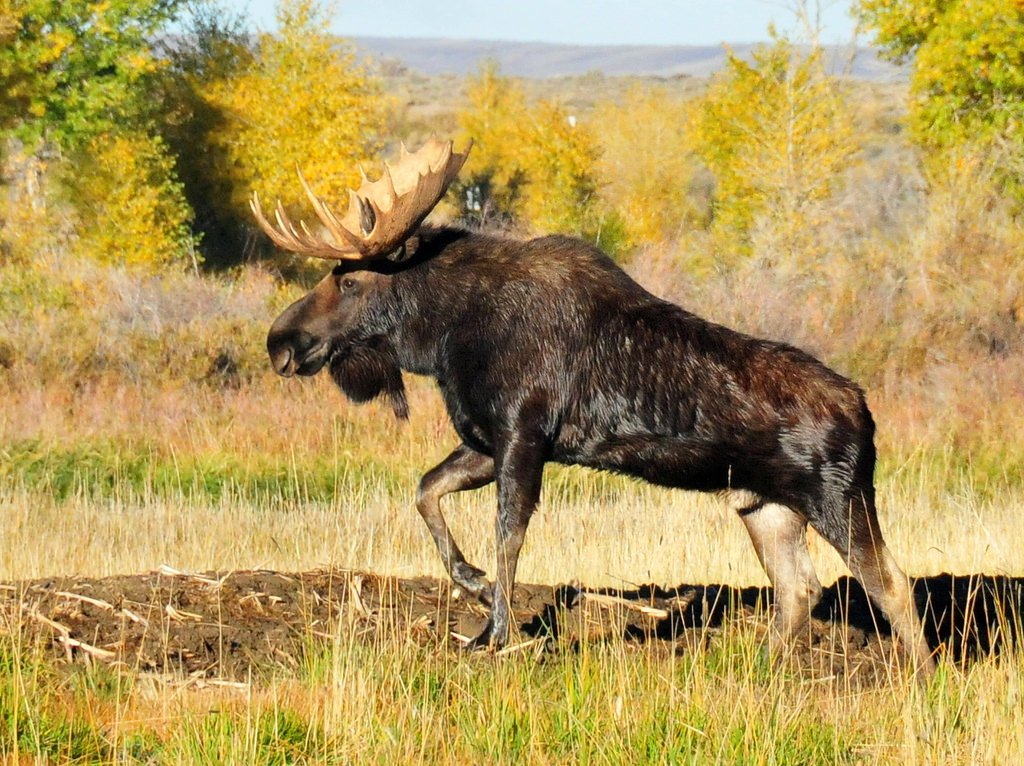
Bull moose in willow cover. Photo: Tom Koerner/USFWS, public domain.
License and district research
Montana requires prerequisite Conservation and Base Hunting licenses to apply. The moose license is valid only according to its district and animal specifications. Read the 2026 Moose, Sheep, Goat and Bison regulations, then open the same district in the Hunt Planner for boundary, access and statistics.
Montana has published corrections to the printed 2026 regulations. The online correction controls over an older paper copy. Save the legal description and check it again immediately before the hunt.
Decide whether you could use the license before applying
The seven-year waiting period follows receiving a moose license, not a successful harvest. A hunter who draws and then cannot make the trip should not assume an unused tag preserves next year’s eligibility. Check your license history in MyFWP and ask FWP to resolve any special circumstances before applying. FWP’s moose license requirements explain the waiting period and prerequisite licenses.
Our planning recommendation: write down the district you can realistically scout, the days your recovery partner can attend, and the maximum amount you can spend if drawn. If one of those is unresolved, investigate a points-only option and its eligibility rules instead of entering for a hunt you cannot support. Neither route promises a future license.
Bonus points are not a place in a guaranteed queue
FWP’s current system uses squared bonus points plus the application’s chance. Its FAQ also warns that accumulated points are not used in that drawing if you do not purchase the bonus point with the application. The separate points-only purchase period does not let an applicant retroactively add a point they declined when applying. Read the FWP bonus-point explanation before checkout.
Worked example: two accumulated points plus one purchased with the application makes three; 3 × 3 + 1 gives ten chances under the published formula. That is ten entries, not a ten-percent probability. Your chance also depends on the other applicants’ weighted entries and the licenses available. Do not substitute deer-and-elk combination preference-point advice for moose bonus-point research.
Use draw and harvest data carefully
Drawing statistics show applicant competition, while harvest reports show what license holders reported. Neither proves access, animal quality or future odds. Compare multiple years, resident and nonresident pools, animal restrictions and district changes. A high harvest percentage describes hunters who obtained a license; it does not describe the probability of obtaining one.
Access and habitat
FWP’s moose management overview describes northwest forests, southwest willow valleys and eastern riparian habitat. Those settings require different trip plans. The following are our logistical interpretations of those habitat differences, not district rankings or current animal-location reports.
| Landscape | Question to settle before choosing a hunt |
|---|---|
| Northwest forest, including Cabinet Mountain country | Can you move a loaded pack through the actual timber and slope, and is the nearest road legally open to your vehicle? |
| Southwest willow valleys, including Centennial and Big Hole country | Does the usable approach cross a ranch, wet ground or a watercourse? Identify a legal recovery route, not just a viewing position. |
| Eastern riparian corridors | Which bank, parcel and entry point are covered by your license and permission? A river corridor on a map is not blanket access. |
Montana law requires permission before hunting private property, including entry to retrieve wildlife or cross private land to public land. Use Block Management only where the current property rules allow your intended hunt. Type 1 generally uses hunter-administered permission, such as a sign-in box; Type 2 requires permission administered by the landowner or a representative. Neither label means unrestricted vehicle travel or automatic moose access. Read the individual map’s species, dates, reservation and vehicle conditions in FWP’s access instructions.
Long season, changing conditions
A season extending into late November can move from warm, dry archery conditions to snow, ice and short daylight. Build separate access and recovery plans for early and late dates. Roads that are legal in September may become impassable or seasonally restricted later.
Recovery and reporting
Before hunting a wet drainage or steep timber pocket, decide how many loaded trips the crew can complete and where cooling begins. Confirm tag validation, evidence-of-sex, inspection and reporting requirements in the current booklet. If an animal is marked or radio-collared, follow FWP instructions for returning the marker.
Build a Montana application budget and a separate hunt budget
Record the Conservation and Base Hunting prerequisites, nonrefundable application fee and any optional bonus-point purchase separately from the moose license. FWP’s moose fee page lists resident and nonresident amounts; verify the checkout total and whether you already hold a prerequisite license before paying.
For the hunt itself, compare two realistic itineraries: one scouting visit followed by a single longer hunt, or repeated shorter visits. Add the extra fuel, lodging, partner time and cold-storage arrangements to each. A longer legal season is useful only if your access and recovery support remain available on the dates you can actually hunt. Keep a written cancellation and weather reserve rather than treating the state license fee as the trip’s total cost.
Official Montana resources
- Montana moose species guide and 2026 regulations
- Current Montana hunting regulations and corrections
- Montana Hunt Planner
- Application dates and drawings
- Montana hunter access and Block Management
Next: Use the moose planning guide to build the extraction system, then compare states in the hub.