How to Plan a New Mexico Pronghorn Hunt: Draw, Units and Access
Last reviewed: August 21, 2026
Research note: Big Game Ledger has not hunted New Mexico pronghorn firsthand. This guide synthesizes current New Mexico Department of Wildlife (NMDOW) regulations, draw guidance, access resources and reporting data. Rules, hunt codes, quotas, land status and fees can change. Verify every choice in the current New Mexico Hunting Rules and Information before applying, buying a license or traveling.
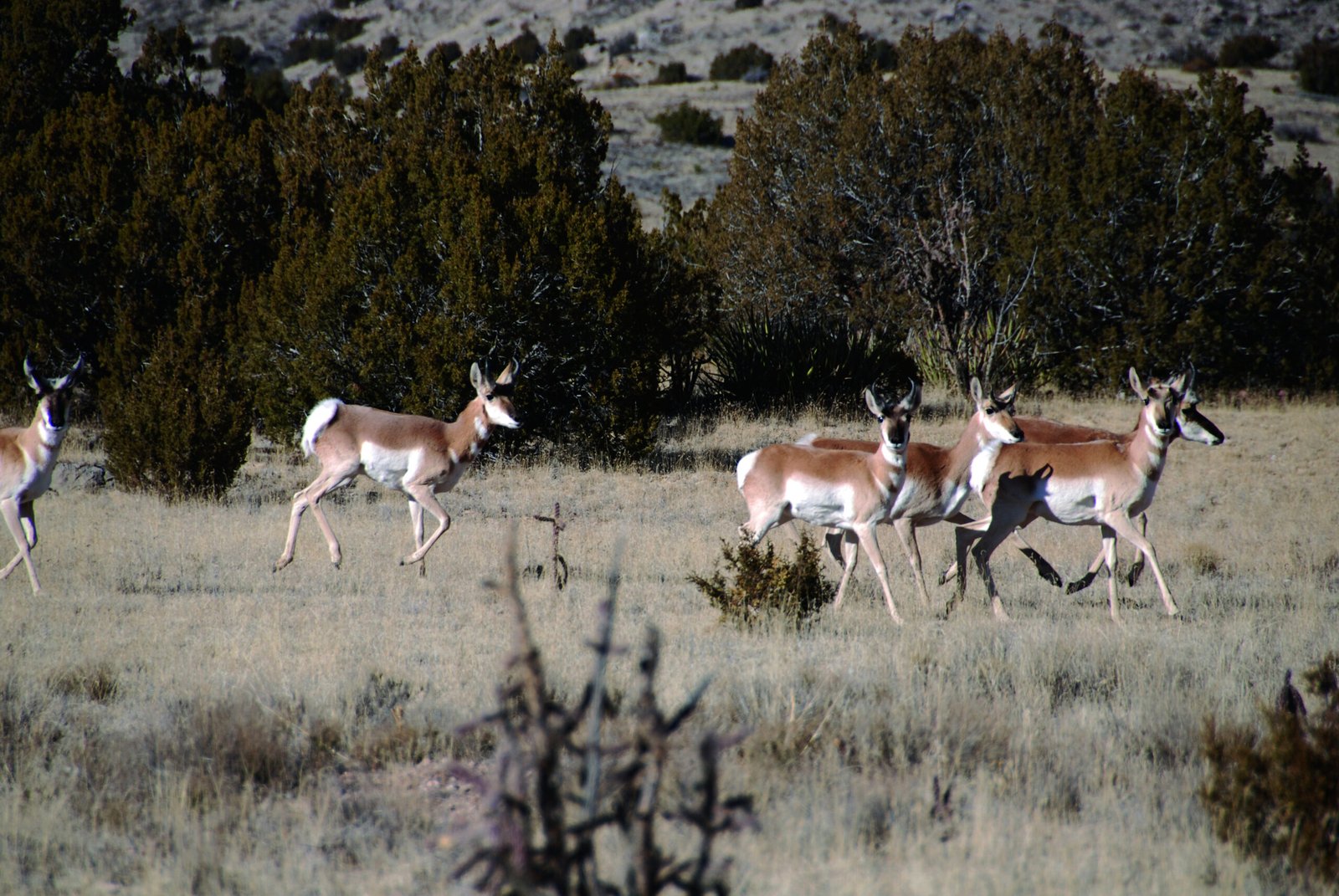
Pronghorn at Sevilleta National Wildlife Refuge, New Mexico. Photo: USFWS remote camera, public domain.
New Mexico pronghorn planning begins with a choice between two fundamentally different license paths. Public-land opportunity is distributed through a random draw. Private-land-only opportunity generally starts with written landowner permission and a license matched to the correct unit, season, sporting arm and bag limit. Confusing those paths can leave a hunter holding a license that is unusable on the ground he or she expected to hunt.
New Mexico pronghorn planning at a glance
| Planning item | 2026–2027 rule |
|---|---|
| Public-land application deadline | March 18, 2026, before 5 p.m. Mountain Daylight Time. |
| Draw results | Available April 22, 2026. |
| Draw system | Random sequence; New Mexico does not award preference points to previously unsuccessful applicants. |
| Application group | Up to four hunters may apply together for pronghorn. |
| Private-land-only license | Requires the matching hunt code and written landowner permission; never valid on public land. |
| Access warning | Ranch-wide, unitization, Open Gate and State Trust arrangements can change how a mapped parcel is treated. Check the current agreement and signs. |
| Mandatory report | Every pronghorn license holder must file a harvest report, even if the hunter did not hunt or harvest. |
Why New Mexico is different
New Mexico does not use a preference-point system for its public big-game draw. Every valid application receives a randomly assigned sequence number, and the computer examines the complete application in that order. It tries the first choice, then the second and third, subject to the license pools. A hunter who failed in prior years receives no built-in priority the next year.
The other defining feature is the state’s private-land structure. A public-land draw license can be valid on legally accessible public land within the specified GMU or hunt area, participating ranch-wide properties, and private land where the hunter has written permission. An over-the-counter private-land-only license is restricted to eligible private deeded acreage where written permission has been obtained. It is not a shortcut to BLM, Forest Service or State Trust land.
How the 2026 public draw works
NMDOW’s draw guidance and the current rules establish three license pools:
- a minimum of 84% for New Mexico residents;
- 10% for residents or nonresidents applying with a New Mexico registered outfitter; and
- 6% for nonresidents applying without a registered outfitter.
These percentages do not mean every small hunt will necessarily issue a license in every pool. NMDOW warns that it is extremely unlikely for a registered-outfitter applicant to receive a hunt code with six or fewer licenses, or for an unguided nonresident to receive a hunt code with 12 or fewer licenses. A mixed resident/nonresident group also needs enough licenses to satisfy every applicant in the applicable pools when the application is examined.
For pronghorn, focus on the first three choices. The fourth-choice process described by New Mexico is for remaining deer and elk licenses, not pronghorn. Compare the complete hunt code and the applicant pool in the official odds report; do not borrow a percentage from a different pool or species.
2026 application calendar and prerequisites
- Before applying: create or confirm the hunter’s NMDOW customer account and identification number. Do not create a duplicate account.
- March 18 before 5 p.m. MDT: public pronghorn draw application deadline.
- March 18: late deadline for required 2025–2026 deer, elk, pronghorn and turkey harvest reports. Missing required reports causes draw applications to be rejected.
- March 25: 2026–2027 over-the-counter license types become available through regular sales channels.
- April 1: the 2026–2027 license year begins.
- April 22: big-game draw results become available.
- July 1: the current rules schedule private-land pronghorn licenses to become available.
Draw applicants must buy a nonrefundable 2026–2027 Game-Hunting License or Game-Hunting & Fishing License and the Habitat Management and Access Validation when applicable. The full species license charge is collected with the application. An unsuccessful applicant receives the draw-license fee back, but not the application fee, base license or other nonrefundable purchases.
2026–2027 fees to budget
| Item | Resident | Nonresident |
|---|---|---|
| Public-draw pronghorn license | $70 | $423 |
| Private-land-only pronghorn license | $63 | $410 |
| Game-Hunting License | $25 | $90 |
| Junior Game-Hunting License | $10 | $15 |
| Habitat Management and Access Validation | $4 when required | |
| Habitat Stamp | $10 when hunting on applicable Forest Service or BLM land | |
The public-draw pronghorn price includes the nonrefundable application fee of $7 for residents or $13 for nonresidents. Vendor and carcass-tag charges may also apply. Always review the checkout total and current fee table rather than treating these figures as a future-year quote.
Public-land draw license versus private-land-only license
| Question | Public draw | Private-land only |
|---|---|---|
| How obtained? | Random public draw. | Purchased through authorized sales channels after securing a workable private-land plan. |
| Where valid? | Open public land in the listed unit or hunt area, ranch-wide properties open under their agreement, and private land with written permission. | Private deeded acreage in the selected GMU with written permission; not public land. |
| Hunt code | The drawn code controls unit, dates, sporting arm, fee type and bag limit. | Must match the corresponding public hunt’s unit, dates, sporting arm and bag limit unless a separate private code is listed. |
| Can one hunter hold both? | No. New Mexico permits only one pronghorn license per hunter in the license year. | |
The current private-land section lists opportunity in Units 4, 14, 41, 42, 46, 47, 48, 50, 52, 54, 55, 56, 57, 58 and 59. Sales are specifically limited in Units 41, 42, 47, 56, 57, 58 and 59. Other codes may be unlimited, but “unlimited” refers to license quantity—not open access or unlimited animals. Review the exact table in the current pronghorn regulation section.
Where to begin unit research
The following groups are research starting points, not rankings. New Mexico hunt codes sometimes combine units, split units by road or river, restrict a hunt to a military installation, or change which sporting arm is legal. Use the official GMU maps together with the hunt table.
| Research region | Examples in the 2026 table | Primary planning issue |
|---|---|---|
| Northwest and west-central | Combined Units 2, 7, 9 and 10; Units 12, 13, 15, 16, 17 and 18 | Many individual hunt codes have modest quotas. Compare public acreage, legal approaches and the correct applicant pool before judging odds. |
| South-central and southwest | Units 19–27, including a White Sands Missile Range hunt in Unit 19 | Installation-specific access, check-in, access fees and unit combinations can control whether the hunt is practical. |
| Southeast plains and basins | Units 29–40, including north/south Unit 31 and east/west Unit 32 divisions | Road or river splits, unitization agreements and mixed federal, State Trust and private parcels demand precise mapping. |
| Northeast and high plains | Units 41, 42, 47 and 56–59 | Both draw and private-land paths exist, while several private-land license totals are capped. Permission and parcel verification are central. |
| Northern private-land system | Units 4, 14, 46, 48, 50, 52, 54 and 55 | Private hunt codes include different archery, muzzleloader and any-legal-arm dates. A license is useful only after permission and boundaries are confirmed. |
Use draw and harvest reports correctly
The 2026 draw reports show applicants and successful applications by hunt code, choice and pool. They are historical evidence, not a promise. Random sequence, group size, quotas and annual applicant behavior can all change the outcome.
NMDOW’s harvest-report library provides unit- and hunt-level context such as licenses, reporting, estimated hunters, success, harvest, satisfaction and days hunted. Reported success can be influenced by private access, the number of hunters who actually went afield, season length, weapon and bag limit. Do not convert a historical success percentage into a forecast for one applicant.
Access rules can redraw the practical map
Private land
Written permission is required while hunting private land. Record the landowner or authorized contact, dates, legal description or map, guests, vehicle use and any fee or ranch rule. A handshake, visible herd or app boundary is not a substitute for the required written permission.
Ranch-wide agreements
Participating ranches combine deeded and associated public-leased acreage for the agreement. A public draw hunter may use qualifying ranch-wide property in the applicable unit, while an OTC private-land-only license is not valid on a ranch-wide property. Check the current ranch list and signed boundaries before relying on the program.
Unitization agreements
Unitization can treat specified public parcels as private and specified private parcels as open to public hunters. The agreement and current signs control, not the ownership color alone. Review NMDOW’s State Lands and Unitization page immediately before the hunt.
Open Gate
Open Gate leases private land or access corridors for public use. A qualifying hunter does not need additional permission or an access fee on an enrolled property, but the posted property rules, dates, activities, scouting restrictions and designated roads apply. Confirm the property is still enrolled for the species and season.
State Trust and federal land
New Mexico’s current State Trust easement runs through March 31, 2028 for most participating lands, but access points, camping areas, unitization and closures must be checked. On BLM and Forest Service land, verify the agency route system, current fire restrictions and whether the $10 Habitat Stamp is required.
A practical New Mexico scouting sequence
- Choose the license path before choosing a famous unit.
- Write down the complete hunt code, bag limit, sporting arm and date range.
- Open the official GMU map and mark public, private, State Trust, Open Gate, ranch-wide and unitized parcels separately.
- Confirm at least three legal entry routes and a backup area.
- Use the draw report for the correct resident, guided or unguided nonresident pool.
- Use harvest data only after matching the exact hunt code and public/private type.
- Scout water, shade, low terrain folds, glassing points and recovery routes.
- Recheck permission, closures, fire conditions and property signs immediately before travel.
Field strategy and gear priorities
New Mexico pronghorn country can combine open grassland, cholla, juniper, broken mesas, agricultural edges and long exposed approaches. Glass from a position that does not skyline the hunter or vehicle. Use shallow drainages and terrain folds for movement, and plan around the sun and wind rather than expecting brush to conceal every stalk.
- binoculars and a stable tripod for systematic glassing;
- a rangefinder and a practiced, method-appropriate shooting support;
- offline property maps plus backup power and a paper reference;
- water, sun protection, eye protection and a wind layer;
- durable knee and hand protection for low approaches where appropriate;
- game bags, cutting tools, gloves and a rapid cooling plan; and
- printed or offline permission, license, hunt code and current regulations.
Use the hunting binocular guide, tripod guide and meat-care kit to build those systems by function.
Budget beyond the license
| Category | Include |
|---|---|
| Application | Base Game-Hunting License, HMAV, application/species fee and applicable Habitat Stamp |
| Access | Permission arrangement, ranch fee if any, scouting trips and installation-specific fees |
| Travel | Fuel or airfare, rental vehicle, lodging/camping and meals |
| Field | Maps, water, ice, game bags, emergency communication and weather margin |
| Recovery | Coolers, processor or home-processing supplies and transport |
There is no defensible single “average New Mexico pronghorn cost.” A resident public draw, nonresident guided application and private-ranch hunt are materially different products.
Final checklist
- Confirm the full 2026 hunt code and applicant pool.
- Verify the March 18, 5 p.m. MDT deadline and payment card.
- Resolve every prior mandatory harvest report before applying.
- Map legal access inside the actual hunt boundary.
- Obtain written permission before relying on private land.
- Check ranch-wide, unitization, Open Gate and State Trust status for the current dates.
- Read tagging, proof-of-sex, transport and legal-sporting-arm rules.
- Save the harvest-report requirement and confirmation number after the season.
Official New Mexico resources
- 2026–2027 Hunting Rules and Publications
- 2026–2027 Pronghorn rules and hunt tables
- Big Game and Draw Hunts
- How the New Mexico Draw Works and 2026 Odds Reports
- Pronghorn Private Lands
- Big-Game Unit Maps
- Open Gate Private Lands
- State Lands and Unitization
- Land Access Rules
- Harvest Reporting and Annual Reports
Bottom line: New Mexico offers a true random public draw and a separate private-land path. The strongest application is not the one with the loudest unit reputation; it is the one whose complete hunt code, applicant pool, legal access, permission and field plan all survive verification.