How to Choose a Hunting Rangefinder for Western Big Game
A hunting rangefinder should do one job quickly: give you a dependable distance to the target or terrain feature you actually selected. In western country, steep angles, dark timber, broken ridgelines, weather, and long sightlines can make that harder than the maximum-distance number on the box suggests.
This research-based guide explains which features matter, where marketing specifications can mislead, and how to match a rangefinder to an elk or mule deer hunt. Big Game Ledger has not field-tested every model mentioned by manufacturers; the recommendations below synthesize manufacturer documentation and practical planning considerations.
The short answer
For most western big-game hunters, the useful baseline is a compact 6x or 7x unit with angle-compensated distance, a display you can read in bright sun and near darkness, fast target acquisition, scan mode, weather resistance, a common replaceable battery, and enough real-world range on trees and animals—not merely reflective targets. Buy for the distances you can identify and practice for, not the largest advertised number.
Three rangefinders worth comparing
Research disclosure: Big Game Ledger has not field-tested these three rangefinders. They are research candidates for different use cases, not a universal ranking. The linked profiles separate manufacturer specifications, independent-test evidence, limited public owner-discussion themes and the limits of the available evidence.
Affiliate disclosure: Big Game Ledger may earn from qualifying purchases made through the Amazon links below, at no additional cost to you.
| Candidate | Research fit | Main caution |
|---|---|---|
| Leupold RX-1400i TBR/W Gen 2 | Lightweight rifle-and-bow value path | 5× view, no tripod socket and multiple modes to learn |
| Vortex Razor HD 4000 GB | Premium long-range and integrated GeoBallistics path | Heavier body, more setup and higher system complexity |
| SIG SAUER KILO3K | Compact Applied Ballistics and BDX path | Connected workflow and stated 800-meter onboard-solver limit |
Leupold RX-1400i TBR/W Gen 2: the practical value path
Leupold publishes a 5×21 format, 5.1-ounce weight and separate maximum ranges of 900 yards on deer, 1,200 yards on trees and 1,400 yards on reflective targets. Its LOS, Bow Mode, Flightpath and TBR/W functions make it the simplest of these three candidates to frame for both archery and rifle use, but each displayed output still needs to be learned and verified.
Read the Leupold RX-1400i Gen 2 research profile, or view the Leupold RX-1400i TBR/W Gen 2 on Amazon (affiliate link). Confirm part number 183727 before buying.
Vortex Razor HD 4000 GB: the premium integrated path
Vortex publishes a 7×25 format, 10.1-ounce weight, tripod compatibility and separate maximum ranges of 2,200 yards on deer, 2,500 yards on trees and 4,000 yards on reflective targets. The GeoBallistics solver, environmental sensors and Kestrel pairing can reduce steps for a practiced user, but they also create more configuration and more ways for bad inputs to produce bad outputs.
Read the Vortex Razor HD 4000 GB research profile, or view the Vortex Razor HD 4000 GB on Amazon (affiliate link). Confirm Vortex SKU LRF-252 rather than relying only on the Razor HD 4000 family name.
SIG SAUER KILO3K: the connected Applied Ballistics path
SIG publishes a 6×22 format, 5.6-ounce weight and separate maximum ranges of 1,500 yards on deer, 1,800 yards on trees and 3,000 yards on reflective targets. The KILO3K supports LOS, angle-modified, archery and BDX modes, but SIG states that Applied Ballistics Ultralite provides an onboard firing solution only to 800 meters; work beyond that limit requires a compatible external workflow.
Read the SIG SAUER KILO3K research profile, or view the SIG SAUER KILO3K 6×22 on Amazon (affiliate link). Confirm SIG SKU SOK3K602 and the 6×22 configuration.
The correct choice depends on the hunting method, realistic ranging distance, display fit, willingness to configure ballistic tools and the complete shooting system. A range reading or calculated hold does not establish that a shot is safe, legal or ethical.
1. Separate advertised range from usable hunting range
A rangefinder’s largest number usually refers to a highly reflective target under favorable conditions. Trees, rocks, brush, and animals return less laser energy. Atmospheric conditions, target color, target size, hand movement, and the angle of the surface can also affect a reading. SIG SAUER’s official rangefinder FAQ specifically notes that maximum distances differ for reflective targets, trees, and animals and that environmental and atmospheric conditions affect performance.
Compare three specifications when a manufacturer publishes them: reflective-target range, tree range, and deer- or animal-range. The animal figure is generally the more useful comparison for a hunter, but it is still a ceiling rather than a promise for every situation.
2. Make angle compensation a priority
Western hunts regularly produce uphill and downhill lines of sight. Straight-line distance and the horizontal component of that distance are not the same. An angle-compensated rangefinder uses its inclinometer and internal calculation to provide an adjusted value. Nikon describes this as horizontal-distance versus actual-distance display modes, while Leupold describes its True Ballistic Range modes as accounting for shot angle.
The safest buying decision is to choose a model that can clearly show both line-of-sight distance and an angle-adjusted distance, then learn exactly what each display mode means before the hunt. Never assume two brands calculate or label their modes identically.
3. Prioritize the display before advanced software
A distance is useless if you cannot read it. Red OLED displays are often easier to see against dark timber than a thin black LCD, but brightness still matters. Look for several manual brightness levels or reliable automatic brightness control. The reticle should remain visible without blooming so brightly that it obscures a small target at dawn or dusk.
- Magnification: 6x is common and easier to hold steady than very high magnification.
- Eye relief: Important for eyeglass wearers and for acquiring the display quickly.
- Diopter adjustment: Lets you focus the display for your eye.
- Field of view: A wider view makes it easier to relocate an animal after lowering binoculars.
- Display brightness: Test it against both shaded timber and open sky.
4. Target modes and scan mode matter in broken terrain
Brush, branches, rain, and intervening terrain can produce a reading from the wrong object. Some rangefinders offer first-target and distant-target priority. Nikon explains that first-target priority favors the nearest measured object, while distant-target priority favors the farthest target in a group. Neither is universally correct: the useful mode depends on whether you are ranging an exposed animal, a tree behind it, or an opening through brush.
Continuous or scan mode is especially useful for sweeping a slope, following a moving animal, and comparing multiple terrain features. A quick response time and a clear confirmation indicator reduce uncertainty, but hunters should still range more than once and cross-check nearby landmarks.
5. Decide whether you need ballistic features
Basic angle compensation is useful for nearly every western hunt. A built-in ballistic solver, wind input, Bluetooth connection, or custom ballistic profile can be useful only if you are willing to configure and verify it. The rangefinder’s output is not a substitute for confirming rifle data, ammunition performance, zero, field position, and personal shooting limits.
Bowhunters should confirm that the unit has an archery-appropriate mode and works reliably at short distance and steep angles. Rifle hunters comparing ballistic modes should understand whether the display shows horizontal distance, corrected distance, holdover, dial correction, or a wind solution. Treat the manual as required reading.
6. Choose a unit you can operate with cold hands
Compact size helps, but tiny buttons and deep menus can become liabilities with gloves, precipitation, or a rushed setup. Two-button controls are usually faster to learn. Check whether you can change yards and meters accidentally, whether the mode remains saved after shutdown, and whether the focus ring stays in place.
- Operate every essential mode without looking at a cheat sheet.
- Carry a spare battery in a protected pocket.
- Confirm the battery type is easy to source.
- Use a tether or secure pocket rather than leaving the unit loose.
- Clean the objective lens and laser aperture according to the manufacturer’s instructions.
7. Weather resistance is not the same as waterproofing
Read the exact ingress or immersion statement. “Rainproof,” “weather resistant,” and “waterproof” do not necessarily describe the same protection. Also check the operating-temperature range, especially for late-season hunts. Keep the laser window unobstructed and avoid letting condensation, dust, or snow cover the emitter or receiver.
Standalone rangefinder or rangefinding binocular?
| Format | Best fit | Main tradeoff |
|---|---|---|
| Compact standalone rangefinder | Hunters who already own binoculars, want low pack weight, or share ranging duties | Requires switching between binocular and rangefinder |
| Rangefinding binocular | Hunters who want observation and ranging in one view | Higher cost, weight, battery dependence, and system complexity |
A standalone unit is usually the cleaner starting point. A rangefinding binocular can reduce movement and speed up a sequence, but it combines two important tools into one electronic device. Compare that choice with our guide to choosing binoculars for western big-game hunting.
A practical buying checklist
- Define your hunt type: archery, rifle, or both.
- Set a realistic maximum distance based on identification and practiced capability.
- Require angle compensation and confirm what the displayed value represents.
- Compare animal and tree range—not only reflective-target range.
- Check display visibility in bright and dark conditions.
- Confirm scan mode and target-priority behavior.
- Test the controls with gloves.
- Verify weather protection, battery type, warranty, and service support.
- Decide whether ballistic connectivity solves a real need or adds complexity.
- Practice ranging terrain features before the hunt.
How to test a rangefinder before the hunt
Range known targets at short, medium, and longer distances. Repeat readings from a supported position and freehand. Test light-colored rock, dark timber, trees, and angled terrain. Compare scan mode with single measurements. Then practice the complete sequence with the rangefinder stored where you will carry it.
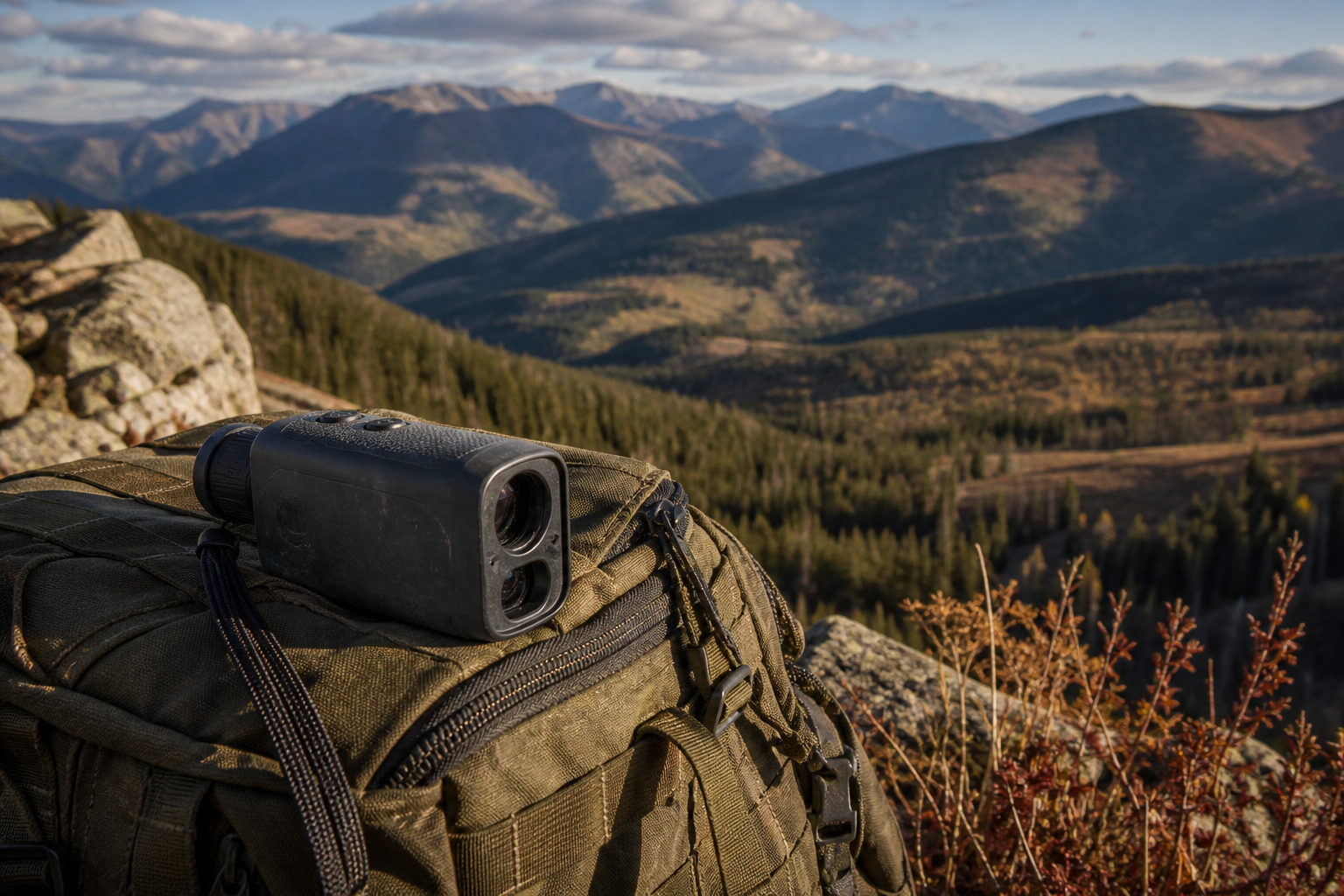
The rest of the system matters too. A rangefinder needs a secure, repeatable place in your hunting backpack, and its weight and spare battery should appear on your western big-game gear checklist. Browse the Gear hub to build the complete system rather than buying each item in isolation.
Research sources
- Nikon: How laser rangefinders work
- Nikon: Angle compensation and target-priority modes
- Leupold: Rangefinder support and angle-compensated modes
- SIG SAUER Electro-Optics: Rangefinder specifications and environmental limits
Always follow the manufacturer’s instructions and confirm current hunting regulations with the responsible wildlife agency. Distance information supports planning; it does not determine whether a shot is safe, legal, or ethical.