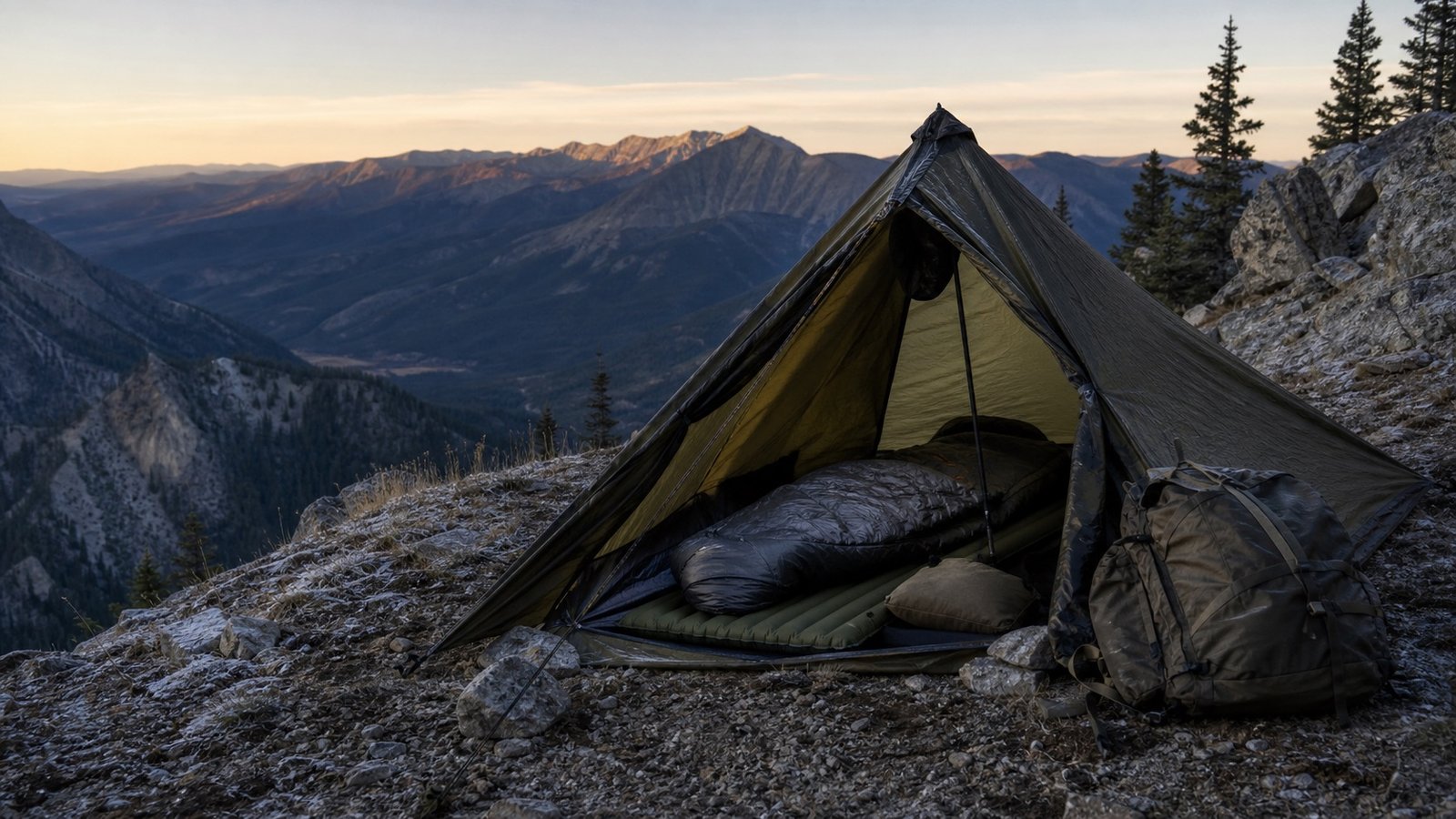
How to Build a Backcountry Hunting Sleep System
A backcountry hunting sleep system has one job: preserve enough warmth and recovery to let the hunter function safely the next day. The system includes more than a sleeping bag. Shelter choice, campsite exposure, ground insulation, moisture, clothing, food storage and repair planning all affect the night.
That is why a bag's printed temperature number should not drive the entire purchase. A highly insulated bag on an inadequate pad can still feel cold. A warm pad and bag inside a poorly ventilated shelter can accumulate moisture. A strong shelter pitched below dead branches or in a drainage is still a poor camp.
This guide provides a research-led framework for assembling and testing those parts as one system.
Research note: Big Game Ledger has not field-tested the products or systems discussed here. This guide synthesizes public safety guidance, standardized test information and manufacturer education. Weather, product specifications and individual cold tolerance vary. Verify current instructions and conditions before entering the field.
Start With the Hunt and the Consequence of Failure
Before comparing shelters, bags or pads, define the hunt:
- Will camp be reached by vehicle, horse or backpack?
- What is the lowest credible overnight temperature, not only the average forecast?
- Are rain, wet snow, sustained wind or snow loading realistic possibilities?
- Will camp move every day, or stay in one location?
- Is the route above timberline, in exposed sage country or inside forest?
- Are established campsites required?
- What food-storage rules apply in bear country?
- How many wet days could occur before the system can be dried?
- Does the hunter sleep warm, sleep cold or have known circulation or medical concerns?
- How far is the camp from a reliable exit or heated shelter?
The National Park Service advises campers to consider wind, lightning, flash floods, dead trees and falling branches when selecting a site. Those hazards can matter more than saving a few ounces of shelter weight.
The Five Jobs of a Sleep System
A useful backcountry hunting sleep system must perform five connected jobs:
- Select a campsite that avoids preventable hazards.
- Keep precipitation and wind from overwhelming the insulation.
- Reduce conductive heat loss to the ground.
- Trap body heat with appropriately rated insulation.
- Manage internal and external moisture across multiple nights.
No single product completes all five jobs. Treat the shelter, pad, bag or quilt, sleep clothing and campsite as one chain. The weakest link can determine the outcome.
1. Choose the Shelter for the Expected Load
Shelter decisions start with credible weather and terrain, not a season label alone.
Double-Wall Backpacking Tent
A double-wall tent separates the occupied space from the waterproof fly. It can offer bug protection, defined floor coverage and useful condensation management. The tradeoffs may include more pieces, more setup steps and additional packed weight.
Single-Wall or Floorless Shelter
Single-wall tents, pyramids and floorless shelters can provide substantial covered space for their carried weight. They require disciplined site selection, anchoring, ventilation and ground-moisture management. A floorless design also changes how the hunter manages insects, mud, drainage and small equipment.
Tarp and Bivy Combination
A tarp and bivy can be compact and flexible in protected terrain. Coverage, wind-driven precipitation, splash, insects and condensation require careful planning. This is not automatically the safer choice simply because it is lighter.
Four-Season or Mountaineering Shelter
When sustained severe wind or meaningful snow loading is expected, a structure designed for those loads may be appropriate. Big Agnes distinguishes lightweight three-season shelters from more heavily built four-season shelters intended for snow and severe mountain conditions. The category name is still not a substitute for checking pole structure, anchors, ventilation, usable space and the manufacturer's intended use.
Whatever the design, set it up before the hunt. Practice with cold hands, gloves, darkness and imperfect ground. Carry the stakes, guylines, pole sections and repair parts the actual site requires.
2. Select the Campsite Before Unpacking
The National Park Service recommends level ground that is not a low point and warns against exposed ledges, high peaks, ravines, dead branches and other hazards. A practical camp check includes:
- Look above for dead limbs and unstable trees.
- Look uphill for rockfall, avalanche paths and runoff channels.
- Avoid depressions where water can collect.
- Avoid cliff edges and exposed high points.
- Find ground that allows secure anchors for the expected wind.
- Keep the sleeping area separate from food, cooking and scented items according to current local rules.
- Establish camp before dark when possible.
In bear country, follow the responsible land agency's current food-storage and camp-layout rules. Do not assume that a practice accepted in one unit is legal or appropriate in another.
3. Treat the Sleeping Pad as Insulation
A sleeping pad is not only a comfort item. It reduces conductive heat loss to the ground.
Many current pads publish an R-value measured under ASTM F3340. Sea to Summit describes that standard as a way to compare thermal resistance across pads tested under a common method. A higher measured R-value indicates greater resistance to heat flow, but it is not a personal comfort guarantee.
When evaluating a pad, consider:
- Published ASTM-tested R-value.
- Width and length in the hunter's normal sleep position.
- Stability when turning or sleeping on a side.
- Inflation and valve operation with cold hands.
- Fabric protection from sharp ground, stove debris and equipment.
- Packed size and the consequence of a puncture.
- Repair method and whether it works in cold or damp conditions.
An inflatable pad can lose much of its function after a puncture. Therm-a-Rest's instructions recommend carrying a protective sack and an appropriate repair kit. Practice finding and patching a leak at home. On remote or colder hunts, consider whether a thin closed-cell pad provides useful backup, protects the inflatable pad or adds unacceptable bulk.
4. Read Sleeping-Bag Ratings Correctly
Temperature ratings are comparison tools, not promises.
ISO 23537 laboratory testing can report several values. In simplified terms:
- Comfort is intended to represent a colder sleeper in a relaxed position.
- Limit is intended to represent a warmer sleeper in a curled position.
- Extreme is a survival-risk value, not a target for trip planning.
Sea to Summit notes that the standardized test uses base layers, head insulation and a highly insulated sleeping pad. A hunter using a less insulated pad, sleeping in damp clothing or recovering from a long calorie deficit should not expect the same result.
Western Mountaineering similarly cautions that bag ratings are guidelines and that metabolism, fatigue, hydration, altitude, humidity, wind, shelter and pad insulation all influence warmth.
Compare bags using the same rating type whenever possible. Do not compare one brand's comfort value with another brand's limit value as though they describe the same condition.
5. Decide Between Bag, Quilt, Down and Synthetic
Sleeping Bag or Quilt
A mummy-style bag surrounds the sleeper and normally includes a hood and draft controls. A quilt removes much of the insulation beneath the sleeper, relying on the pad and an attachment system. Quilts can reduce weight and provide room to move, but drafts, pad attachment and head insulation become system questions.
Fit matters in either design. Too much empty space takes more body heat to warm. Too little space can compress insulation, restrict sleep positions or crowd clothing. Test the system while wearing the actual dry sleep layers.
Down or Synthetic Insulation
Down is commonly selected for warmth relative to packed size. Synthetic insulation is often considered where persistent dampness, repeated condensation or limited drying opportunities increase moisture risk. Neither label settles the decision by itself. Shell fabric, construction, fill amount, fit, care and shelter conditions matter.
Sea to Summit notes that damp insulation may lose loft. Protect the sleep insulation inside the pack, keep wet clothing away from it and dry it whenever conditions allow.
Ventilation Is Part of Weather Protection
A sealed shelter can trap moisture from breathing, wet clothing and damp ground. That moisture may condense on the shelter and transfer to the sleep system.
Ventilation does not mean leaving the shelter exposed to precipitation. It means using high and low vents, door position and site orientation to reduce condensation while maintaining weather protection. Store wet outerwear where it cannot soak the bag or quilt.
Never use a stove, flame or unapproved heat source inside a tent. MSR's shelter instructions warn that cooking, lighting or refueling a stove inside a tent can cause fire, burns, suffocation or death. Follow the shelter and stove manufacturers' instructions exactly.
Build a Dry Sleep-Clothing System
Reserve a dry layer for camp and sleep when trip conditions justify it. The system may include:
- Dry base top and bottom.
- Dry socks that are not used for hiking.
- Warm hat or insulated hood compatible with the bag or quilt.
- Insulation that fits without compressing the sleep system.
- A waterproof storage method inside the pack.
Do not assume that wearing every garment will always make the system warmer. Tight layers can restrict circulation, and bulky clothing can compress bag insulation. Test the full combination.
The sleep-clothing plan should also connect to the broader western hunting layering system.
Three Planning Templates
These templates are decision frameworks, not temperature guarantees.
Mobile Early-Season Hunt
- Shelter selected for insects, rain and the site's realistic wind.
- Pad with a published standardized R-value appropriate to the ground conditions.
- Bag or quilt compared by consistent comfort or limit data.
- Lightweight dry sleep layers.
- Patch kit, stakes and guylines matched to the shelter.
The common error is selecting everything for minimum carried weight without testing wind stability, ground insulation or condensation.
Variable Shoulder-Season Mountain Hunt
- Shelter with adequate anchoring, covered entry and ventilation.
- Pad chosen with margin for colder ground and a repair plan.
- Sleep insulation selected for the lowest credible night, not the daytime forecast.
- Dry base layers, head insulation and moisture-protected storage.
- Backup plan for unexpected snow, wet insulation or a delayed exit.
This system must handle transitions: warm afternoons, wet evenings, cold predawn hours and repeated nights without a full dry-out.
Cold Late-Season or Low-Output Hunt
- Shelter intended for the expected wind and snow load.
- Ground insulation with a defensible margin and a failure backup.
- Sleep insulation evaluated using comparable test data and the hunter's known cold tolerance.
- Dry clothing protected independently from wet field layers.
- Communication, exit and emergency-shelter plans appropriate to the distance from help.
Cold-weather planning must include the consequences of injury, exhaustion and an extra unplanned night.
Common Sleep-System Mistakes
Buying the Bag Before Choosing the Pad
The bag cannot compensate reliably for uncontrolled heat loss to the ground.
Treating a Rating as a Guarantee
Rating systems help compare equipment. They cannot predict every sleeper, campsite or weather sequence.
Testing the Shelter Only in the Yard on a Calm Day
Practice anchoring, venting and entering the shelter in wind, darkness and gloves.
Packing Wet Gear With Dry Insulation
Use separate storage and a camp routine that protects the sleep system before other gear is unpacked.
Ignoring the Repair Plan
A pad patch, pole splint, spare cord and compatible tape are useful only if the hunter can deploy them under field conditions.
Choosing an Exposed Camp for the View
A dramatic ridge may create unnecessary wind, lightning and falling-weather exposure. Camp selection is a safety decision.
Bringing a Flame Into the Shelter
Do not cook, light or refuel a stove inside a tent or shelter unless a specific system is explicitly designed, installed and operated under its manufacturer's instructions. Generic backpacking tents are not heated structures.
Run a Controlled Test Before the Hunt
Test the complete sleep system close to a safe exit before relying on it remotely.
- Pitch the shelter using only the parts carried on the hunt.
- Inflate the pad and confirm body coverage, stability and valve access.
- Use the planned bag or quilt with the actual sleep clothing.
- Record temperature, wind, precipitation, ground condition and clothing.
- Check for drafts, compressed insulation and condensation.
- Practice packing wet shelter fabric without wetting the sleep insulation.
- Simulate a pad leak and complete the repair.
- Repeat in colder or wetter conditions without changing multiple variables at once.
A written test record is more useful than a memory that the system felt “pretty warm.”
Know When Cold Exposure Is an Emergency
The National Weather Service identifies hypothermia warning signs that can include uncontrolled shivering, confusion, slurred speech, drowsiness and loss of coordination. Suspected hypothermia requires urgent action and medical attention. Move the person out of exposure, replace wet clothing with dry insulation and follow current emergency guidance.
A sleep system is not a substitute for a communication device, emergency shelter, trip plan and conservative decision-making.
The Bottom Line
The best backcountry hunting sleep system is not automatically the lightest shelter or the lowest printed bag rating. It is a compatible set of parts that manages exposure, ground heat loss, insulation, moisture and credible failure.
Define the hunt, compare standardized values correctly, protect the insulation and test the entire system before committing to a remote camp. Good sleep is not a luxury on a multi-day hunt; it is part of the safety and performance plan.
Continue Planning
- Start with the Western Big-Game Hunting Gear Checklist
- Build a western hunting layering system
- Learn how to choose a hunting backpack
- Learn how to choose hunting boots
- Visit the Big Game Ledger Gear hub
- Read our Review Methodology
Research Sources
- National Park Service: Finding and Setting Up a Campsite
- National Park Service: Wilderness Camping Planning Checklist
- National Park Service: What to Bring—Shelter and Bedding
- National Weather Service: Cold Weather Safety
- Sea to Summit: R-Value and ASTM F3340 Testing
- Sea to Summit: ISO Sleeping-Bag Ratings
- Western Mountaineering: Temperature Ratings
- Big Agnes: Three-Season and Four-Season Shelter Guidance
- MSR: Tent Setup and Safety Guidance
- Therm-a-Rest: How to Repair Your Sleeping Pad