How to Choose a Backcountry Water Treatment System for Hunting
A backcountry water treatment system is not just a filter. It is a complete plan for collecting, treating, carrying, and protecting drinking water when a western hunt moves beyond reliable taps and vehicle access. The right system depends on the organisms and other hazards that may be present, the number of hunters, daily water demand, source quality, temperature, and how quickly the equipment must work.
This guide explains the decision framework without pretending that one device is ideal everywhere. Local land managers, public-health advisories, and product instructions should always take priority over general guidance.
Quick answer: build the system around the source and the consequence of failure
For most remote elk and mule deer hunts, begin with four questions:
- What hazards must the system address? Parasites, bacteria, viruses, sediment, and chemical or algal contamination are different problems.
- How much water must be treated? One mobile hunter has different needs than a spike camp supporting several people.
- How will the treatment method perform in cold, silty, or shallow water?
- What is the backup if the primary device freezes, clogs, breaks, or loses power?
The Centers for Disease Control and Prevention identifies boiling as the best way to kill germs in uncertain water. When boiling is impractical, the CDC recommends filtering and then disinfecting the filtered water. A filter or purifier should be selected by verified treatment claims and instructions, not appearance or marketing language.
Filter, purifier, chemical treatment, UV, or boiling?
Portable filters
A microfilter physically removes organisms larger than its effective pore size. Many backcountry filters are intended to address protozoa, and some are designed to remove bacteria as well. A conventional filter should not automatically be assumed to remove viruses. Check the manufacturer’s verified claims, pore-size language, testing standard, replacement interval, and cleaning instructions.
Purifiers
“Purifier” should describe broader organism reduction than a typical microfilter, but the exact method varies. Some systems combine filtration with another treatment stage; others use chemicals or UV. Compare the organisms addressed, treatment time, water clarity requirements, operating temperature, and capacity instead of treating the word purifier as a universal guarantee.
Chemical disinfectants
Chlorine dioxide and other labeled disinfectants can be compact and valuable as a primary or backup method. Their effectiveness depends on using the correct dose and allowing the full labeled contact time. Cold or cloudy water can affect treatment. The CDC advises filtering before disinfecting, particularly when water contains sediment.
Ultraviolet treatment
Portable UV devices can treat small quantities of clear water when used correctly, but they depend on batteries and adequate light exposure. Cloudy water can shield microorganisms, so prefiltering may be necessary. A UV device also does not remove sediment or chemical contamination.
Boiling
Boiling is dependable for killing germs, but it requires fuel, a vessel, time, and cooling. CDC guidance calls for a rolling boil for one minute, or three minutes above 6,500 feet. Boiling does not make water contaminated by harmful chemicals, toxins, or radioactive materials safe.
Match capacity and flow to the hunt
Published flow-rate numbers rarely tell the full story. Cold water, sediment, elevation, user fatigue, a partially clogged element, and the shape of the source can change real output. Evaluate how many liters must be available at camp, how often the group can refill, and how much time is acceptable at each source.
- Solo mobile hunt: A compact filter or purifier with a small dirty-water reservoir may minimize carried weight.
- Two-person bivy hunt: A larger collection bag can reduce repeated trips and support cooking as well as drinking.
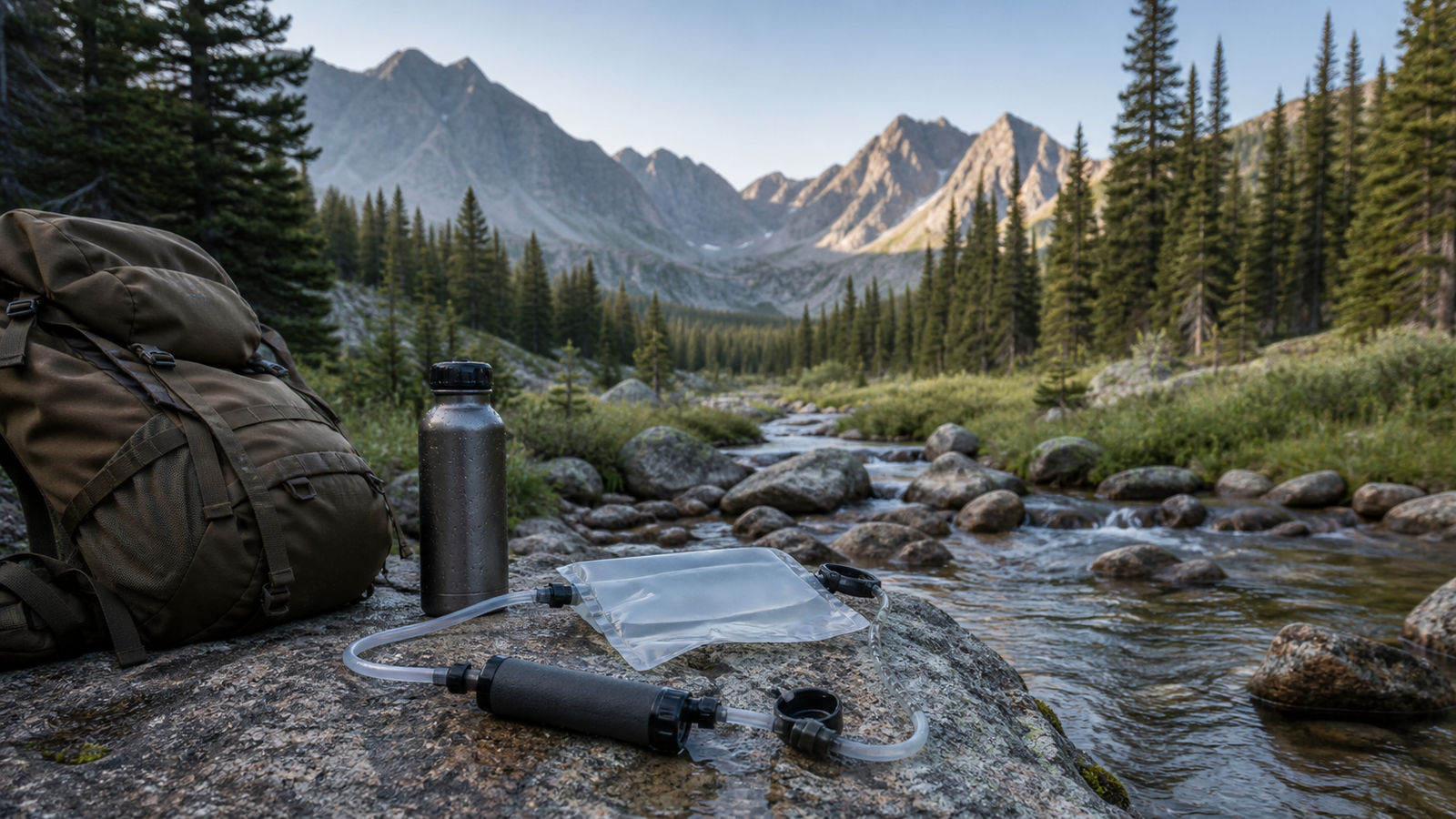
- Spike or base camp: A gravity-style system can process water while other camp work continues, but the reservoir, hanging point, hoses, and clean container must work together.
- Dry-country hunt: Treatment capacity does not replace carrying capacity. Confirm sources before departure and carry enough containers for long gaps.
Plan water separately from the rest of the load in the Western Big-Game Hunting Gear Checklist, then make sure the volume and container placement work with the chosen hunting backpack.
Inspect the complete treatment system
Treatment claims and limitations
Write down what the system is designed to address and what it does not address. Look for clear organism-reduction claims, test standards where provided, service life, and required maintenance. A lower-micron claim alone does not answer every safety question.
Collection in shallow or silty sources
A wide opening can be convenient in a lake but awkward in a shallow seep. Consider a scoop, prefilter cloth, or collapsible collection container that can reach water without stirring up bottom sediment. Allowing cloudy water to settle before treatment can also reduce strain on the primary element.
Dirty-side and clean-side control
Cross-contamination can undo careful treatment. Mark or physically separate dirty-water containers, hoses, scoops, and caps. Keep the clean outlet off the ground and avoid letting untreated water run onto bottle threads or clean-side fittings.
Maintenance and field repair
Confirm whether the unit can be backflushed or cleaned in the field and what clean water is required to do it. Pack the correct coupler, gasket, cap, syringe, or other small part specified by the manufacturer. Test every connection before the hunt.
Cold-weather protection
Hollow-fiber and similar filter elements may be damaged if water inside them freezes. Follow the manufacturer’s storage rules. When freezing is possible, many hunters keep the wet element protected inside clothing or a sleeping system and carry an independent backup treatment method.
Source selection still matters
Choose the best available source before asking equipment to solve the problem. Favor moving water or protected springs when reliable local guidance supports them, collect upstream from camps and animal concentrations when possible, and avoid water with visible algal blooms, unusual color, chemical odor, or nearby pollution.
The National Park Service’s Isle Royale water guidance is a useful reminder that backcountry treatment may not remove cyanotoxins. If officials warn of harmful algal blooms or chemical contamination, use another source.
Redundancy: carry a backup that fails differently
A second identical device can share the same weakness. A more resilient plan pairs methods with different failure modes—for example, a primary filter plus labeled chemical treatment, or a purifier plus enough fuel and cookware to boil an emergency supply. Also carry the instructions and know the required treatment time before leaving service.
Field-test checklist
- Treat the amount of water needed for a normal day, not a single bottle.
- Test from a shallow source and a silty source without contaminating the clean side.
- Measure realistic treatment time with the equipment partially used.
- Practice cleaning or backflushing using only field supplies.
- Confirm every cap, hose, gasket, battery, and adapter.
- Test container placement inside the loaded backpack.
- Protect the wet treatment element during a cold overnight test.
- Use the backup method once and time the full process.
- Record replacement dates, battery condition, and chemical expiration dates.
Bottom line
The best backcountry water-treatment system is the one that addresses the actual hazards, produces enough water for the hunt, remains usable in the expected conditions, and has a practiced backup. Compare verified treatment performance first, then capacity, flow, packability, cold-weather limitations, maintenance, and clean-side control.
Continue building the system
Return to the Big Game Ledger gear hub, build the rest of the system with the big-game hunting gear list, and confirm the treatment setup fits the loaded hunting backpack.
Research note: This guide is based on public-health and land-management guidance plus published equipment principles. It is not a substitute for local water advisories, manufacturer instructions, or medical advice. Big Game Ledger has not represented any product as hands-on tested unless that testing is explicitly documented.