How to Build a Western Hunting Layering System
A western hunt can move from a cold trailhead to a sun-exposed climb, a windy ridge and a motionless glassing session before lunch. The clothing problem is not simply staying warm. It is managing heat and moisture while moving, then preventing rapid heat loss when activity stops.
That is why a layering system is more useful than one heavy hunting jacket. Each piece has a defined job, and the hunter can add, remove or vent pieces as exertion and weather change.
This guide explains how to evaluate those jobs without assuming that one brand, fabric or camouflage pattern is right for every hunt.
Research note: Big Game Ledger has not field-tested the products or systems discussed here. This guide synthesizes public safety guidance, manufacturer education and recurring questions raised by western hunters. Product specifications and weather conditions can change; verify them before purchasing or entering the field.
Start With the Hunt, Not the Clothing Rack
Before comparing fabrics, describe the hunt in operational terms:
- Will most travel be steep and continuous, or will the day alternate between short climbs and long stationary periods?
- Will camp be reached by vehicle, horse or backpack?
- How long could the hunter remain exposed if weather closes a road or delays a return?
- Is the hunt expected to involve dry cold, sustained rain, wet snow or repeated brush contact?
- Will the hunter spend hours glassing from an exposed ridge?
- How much clothing can the pack carry without displacing water, shelter, food or recovery equipment?
- Does the hunter usually run hot, run cold or sweat heavily under a pack?
Two hunters in the same unit may need different systems because their pace, body response, route and glassing plan differ. A forecast provides important inputs, but it does not define the whole clothing system.
The Five Jobs a Layering System Must Cover
The familiar base–mid–shell model is useful, but western hunts often require a more precise five-part framework:
- Move moisture away from the skin.
- Add breathable warmth during low-to-moderate activity.
- Add high-loft warmth when movement stops.
- Reduce heat loss from wind.
- Keep rain or wet snow away from insulating layers.
One garment can perform more than one job, but combining too many jobs into a single heavy piece can reduce flexibility. A quiet insulated jacket may work well during a stationary hunt, for example, but become too warm during a sustained climb and too bulky to carry when removed.
1. The Base Layer: Control Moisture First
The base layer sits next to the skin. Its first job is not to provide maximum warmth; it is to move perspiration away from the body and dry at a useful rate.
The National Park Service describes inner layers as moisture-wicking and quick-drying, while the National Weather Service cautions that cotton dries slowly after strenuous activity. Wet clothing, wind and falling activity can combine into a serious cooling problem.
Common base-layer choices include synthetic fabrics, merino wool and blends. Each involves tradeoffs:
- Synthetic: generally selected for fast drying and high-output use. Odor management and next-to-skin comfort vary by fabric and person.
- Merino wool: often selected for comfort and odor resistance during multi-day use. Fabric weight, durability and drying behavior vary.
- Blends: attempt to combine characteristics of wool and synthetic fibers, but should be judged by the actual garment rather than the fiber label alone.
Fit matters. A base layer should maintain contact with the skin without binding shoulders, restricting a shooting position or bunching beneath a hip belt. A thick base layer is not automatically better; hunters who produce substantial heat may be more comfortable moving in a lighter layer and adding insulation immediately after stopping.
2. The Active Midlayer: Warmth That Can Keep Moving
An active midlayer adds warmth while allowing heat and moisture to escape. Fleece, grid fleece, wool knits and breathable synthetic insulation are common approaches.
Outdoor Research's fleece guidance describes fleece as an insulating midlayer that can continue moving moisture away from a base layer. Hunting-focused systems from KUIU and SITKA similarly separate moisture management, active warmth, static insulation and weather protection into different functions.
When evaluating an active layer, ask:
- Can it vent through a deep front zipper?
- Does it fit beneath pack straps without creating pressure points?
- Does it dry overnight in the expected camp conditions?
- Can the sleeves move freely during climbing and weapon handling?
- Is it quiet enough for the hunting method?
- Does it provide useful warmth without forcing removal every few minutes?
The goal is not to avoid every clothing adjustment. The goal is to make adjustments fast enough that the hunter does not remain overheated and soaked during the climb.
3. Static Insulation: Put Warmth Where the Hunt Slows Down
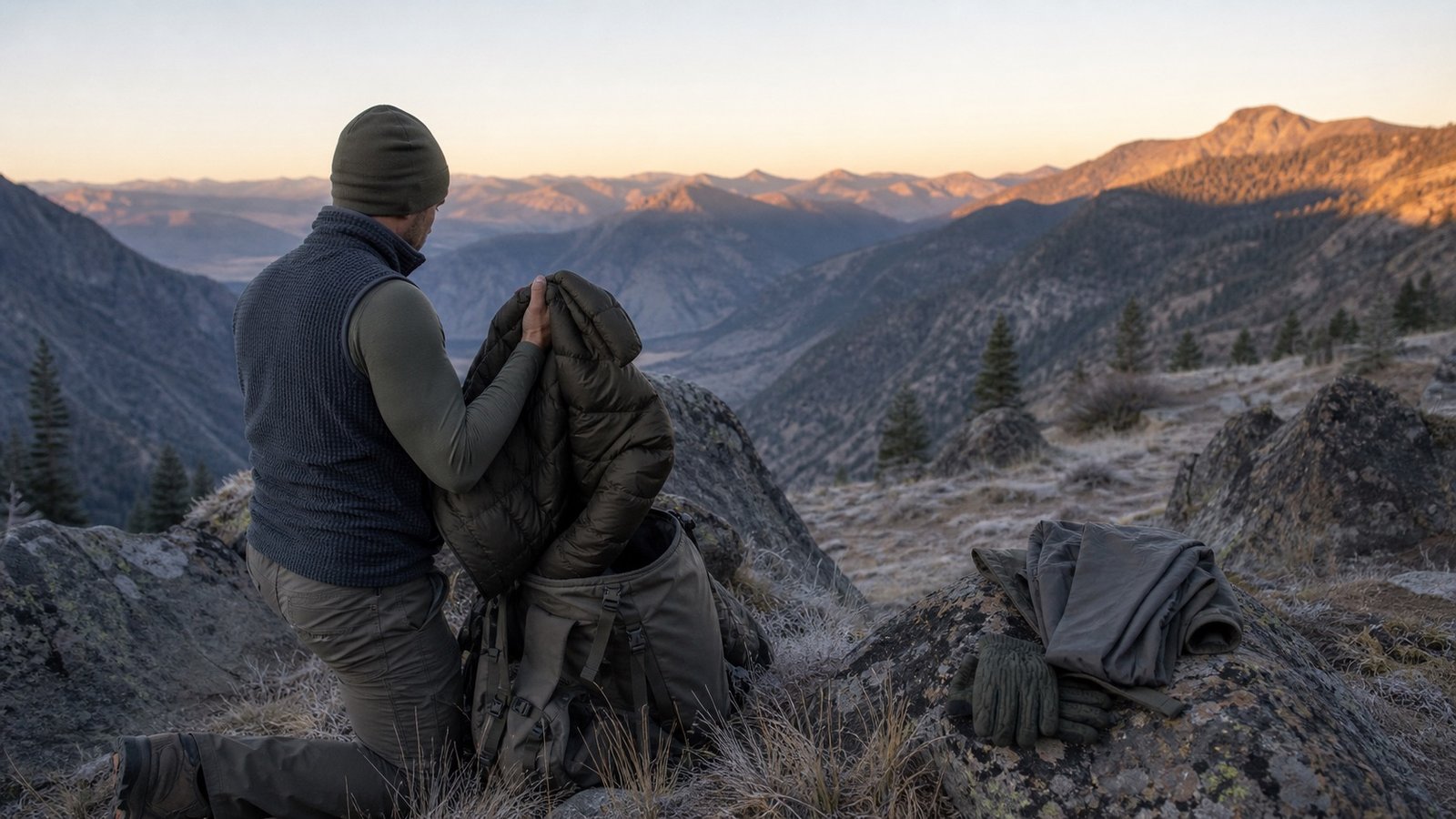
A hunter can generate substantial heat while gaining elevation and lose it quickly after sitting behind optics. Static insulation—usually a high-loft jacket and, in colder conditions, insulated pants—addresses that transition.
Down and synthetic insulation are not interchangeable:
- Down is often chosen for warmth relative to packed size. It needs room to loft and should be protected from moisture.
- Synthetic insulation is often considered where persistent dampness is more likely or drying options are limited. It may carry a different weight-and-bulk tradeoff.
Outdoor Research notes that compressing a down layer beneath a tight shell can reduce its loft. This makes fit a system-level question: a shell that fits comfortably by itself may be too restrictive over the intended insulation.
Static insulation should also be accessible. If the puffy is buried under food, water and recovery equipment, the hunter is more likely to delay putting it on. Store it where it can be added as soon as the pace drops, before a deep chill develops.
4. Wind Protection: Treat Exposed Ridges Differently
Wind can change the comfort and safety margin of an otherwise adequate system. The National Weather Service explains that moving air increases heat loss from exposed skin.
Wind protection can come from a tightly woven active layer, a dedicated wind shirt, a soft shell or a waterproof shell. The right choice depends on precipitation, durability, noise and ventilation needs.
A dedicated lightweight wind layer can be efficient in dry country. A soft shell may add abrasion resistance and quiet movement through brush. A rain shell can also block wind, but may retain more internal moisture during hard movement. The best answer is the least redundant combination that covers the hunt's credible conditions.
5. Rain Protection: Protect the Insulation
A waterproof jacket and pants are not just comfort pieces. Their system role is to keep insulation and next-to-skin layers from becoming saturated while also reducing wind exposure.
The National Park Service's Kobuk Valley guidance recommends warm layers and rain gear for backcountry travel, emphasizing quick-drying materials and breathable rainwear for active use.
Evaluate a rain shell as part of the whole system:
- Does it fit over the planned insulation without crushing loft?
- Can the hood turn with the head and remain useful behind binoculars?
- Can it vent through front, pocket or underarm openings?
- Are cuffs and hem adjustable with gloves on?
- Will the fabric tolerate the expected brush, rock and pack contact?
- Can the pants be put on over boots without a long struggle?
“Waterproof” does not eliminate perspiration. During a hard climb, ventilation and pace management remain important.
Build the Lower-Body System Separately
Hunters often spend more time analyzing jackets than pants, yet the legs generate considerable heat while climbing and may become exposed during long glassing sessions.
A lower-body system may include:
- Quick-drying underwear or a lightweight base bottom.
- A durable, breathable hunting pant.
- A warmer base bottom that can be added for lower-output or late-season conditions.
- Full-length or side-zip rain pants.
- Packable insulated pants for prolonged cold glassing.
Full-length thermal bottoms can be inconvenient if they require removing boots and pants. Garment access and change time matter because a layer that is difficult to add may remain in the pack when it is needed.
Do Not Ignore Hands, Head and Neck
Small accessories can make a system more adjustable without adding the weight of another jacket. A light beanie, warmer hat, neck gaiter, liner gloves and weather-resistant over-gloves allow targeted changes as wind and activity shift.
Evaluate glove systems for dexterity as well as warmth. The hunter should be able to operate navigation tools, optics, zippers and essential equipment without repeatedly exposing wet hands to the wind.
Three Practical System Templates
These are planning templates, not temperature guarantees.
Warm, High-Output Hunt
- Lightweight quick-drying base or sun layer.
- Durable breathable pants.
- Light active midlayer in the pack.
- Compact wind layer or shell according to the forecast and exposure.
- Waterproof jacket and pants when credible precipitation or remote exposure warrants them.
- Light gloves and head protection.
The common error is starting the climb in every available layer. Begin cool enough to move without immediately soaking the base layer, then add protection before the exposed stop.
Variable Early- or Midseason Mountain Hunt
- Lightweight base top and bottom as needed.
- Breathable active midlayer.
- Durable hunting pants.
- Packable static-insulation jacket.
- Wind protection selected for the terrain.
- Waterproof jacket and pants.
- Light and warm glove options, beanie and neck protection.
This system is built around rapid transitions: move light, vent early and add insulation before glassing.
Cold, Low-Output or Late-Season Hunt
- Moisture-managing base layers.
- Active midlayer.
- Static-insulation jacket with adequate loft.
- Insulated pants if prolonged stationary exposure is expected.
- Wind and precipitation shell sized over the full system.
- Layered gloves, warm headwear and neck protection.
- A dry reserve layer protected inside the pack.
Cold-weather planning must account for the return trip, not only the planned glassing location. Conditions that are manageable near a vehicle may be unacceptable several hours from shelter.
Common Layering Mistakes
Dressing for the Parking Lot
Comfort at the trailhead can become overheating ten minutes into the climb. Start with the first sustained effort in mind.
Waiting Until Sweat Is Obvious
Vent or remove a layer before clothing becomes saturated. Pace is part of moisture management.
Carrying Warmth That Is Hard to Reach
Keep static insulation near the top of the pack or in an external-access compartment.
Expecting a Shell to Create Warmth
A shell reduces exposure to wind and precipitation. It does not replace adequate insulation for a long stationary period.
Compressing Insulation
Test the puffy under the shell. If loft is visibly crushed or motion becomes restricted, reconsider garment sizing or layer order.
Buying by Temperature Rating Alone
Clothing performance depends on wind, moisture, duration, activity, food, fatigue, body response and the entire system. A single temperature claim cannot describe all of those variables.
Treating Camouflage as the First Requirement
Concealment may matter, but moisture control, weather protection, fit and access determine whether the clothing works as a system. Solid-color technical layers can fill internal roles where regulations and hunting strategy permit.
Run a Controlled Field Test Before the Hunt
Do not make the first full-system test at elevation.
- Wear every planned layer together and check movement, hood function and insulation loft.
- Load the actual hunting pack and hike on terrain that produces a realistic effort.
- Practice venting and removing layers without unpacking the bag.
- Stop in an exposed location and time how quickly the static insulation can be added.
- Test the rain jacket and pants over the complete system.
- Confirm that wet pieces can be isolated from dry insulation.
- Record what was worn, the conditions and where moisture accumulated.
- Repeat after changing one variable.
This produces a personal decision record instead of a pile of garments selected from unrelated recommendations.
Know When Cold Exposure Becomes an Emergency
Layering reduces risk but does not eliminate it. The National Weather Service identifies warning signs of hypothermia that can include uncontrolled shivering, confusion, slurred speech, drowsiness and loss of coordination. Suspected hypothermia requires urgent action and medical attention; move the person out of exposure and follow current emergency guidance.
Review the National Weather Service cold-safety guidance before a cold-weather hunt and carry a communication and shelter plan appropriate to the location.
The Bottom Line
A useful western hunting layering system is not the maximum number of premium garments. It is the smallest set of compatible pieces that can manage sweat during exertion, preserve warmth during long stops and protect insulation from wind and precipitation.
Describe the hunt, assign every garment a job, eliminate unnecessary overlap and test the whole system under load. The result should be easier to adjust, easier to pack and more defensible than buying one heavy jacket and hoping the forecast holds.
Continue Planning
- Start with the Western Big-Game Hunting Gear Checklist
- Learn how to choose a hunting backpack
- Learn how to choose hunting boots
- Visit the Big Game Ledger Gear hub
- Read our Review Methodology
Research Sources
- National Park Service: Dressing for Winter
- National Park Service: Kobuk Valley Weather and Clothing Tips
- National Weather Service: Cold Weather Safety
- National Weather Service: Understanding Wind Chill
- KUIU: Layering System
- SITKA Gear: Building a Hunting Clothing System
- Outdoor Research: How to Layer With Down
- Outdoor Research: How to Layer Fleece