Big-Game Hunting Resources: A Practical Starting Library
Research method: This curated starting library synthesizes official agency and public-service sources and is not presented as firsthand hunting instruction. Official sources take priority, links require scheduled review, and state-specific rules must be verified for every hunt.
Big-game hunting resources become unreliable when official regulations, map layers, draw reports, opinions, and advertisements are treated as if they carry equal authority.
This library organizes the sources that should come first. It does not replace hunter education, current regulations, landowner permission, local agency guidance, professional training, or the judgment of experienced hunters. It is designed to help a researcher find the responsible authority, document when information was checked, and recognize where another source is still needed.
How to use this library
- Start with the agency that has legal or management authority.
- Use the current year’s document or live system.
- Record the source, publication year, and date reviewed.
- Save the exact page or table supporting an important decision.
- Call or email the responsible office when wording is unclear.
- Use secondary sources to generate questions, not override official answers.
1. Licenses, regulations, and state agencies
State wildlife agencies control most hunting licenses, season structures, legal methods, applications, tagging, reporting, and species-specific requirements in the United States. The U.S. Fish and Wildlife Service maintains a current state-by-state hunting-license directory that links hunters to the appropriate jurisdiction.
Save these state sources for every planned hunt
- Current big-game regulation booklet or official web regulations
- Application guide and license portal
- Draw reports, quotas, and point-system documentation
- Unit maps and legal boundary descriptions
- Harvest, population, herd, or management reports—with methodology
- Mandatory reporting, check-in, testing, and carcass-transport rules
- Hunter-education and field-day requirements
- Agency offices and the appropriate contact for regulation questions
Do not substitute a retailer, commercial odds service, forum, or old PDF for the current agency rule. Those resources may help interpret or organize information, but the responsible agency is the controlling source.
2. Federal land and recreation resources
- Bureau of Land Management hunting and fishing — public-land hunting context, interactive maps, field offices, restrictions, and access reminders.
- U.S. Forest Service — forest and grassland pages, alerts, fire restrictions, roads, offices, permits, and motor-vehicle use maps.
- Recreation.gov — reservations and permits used by many federal recreation sites. Each facility’s rules, deadlines, and fees remain location-specific.
- National Wildlife Refuge System — refuge pages, hunt plans, permits, and location-specific regulations.
For an access decision, identify the local managing office rather than stopping at a national homepage. Confirm gates, seasonal closures, road designations, fire restrictions, camping rules, food storage, and any special hunt permit.
3. Topographic maps and terrain data
- USGS National Map — authoritative national base layers including elevation, hydrography, transportation, boundaries, structures, and imagery.
- USGS topoView — current and historical US Topo maps in downloadable formats.
- USGS topoBuilder — custom OnDemand topographic maps at multiple scales, including recreational formats.
Topography is only part of a hunting map. Use our guide to reading hunting maps to connect contours with access, route difficulty, offline redundancy, and field validation. Confirm ownership, legal access, travel management, current closures, and unit boundaries through their responsible sources. A commercial map layer can be convenient without being the final legal authority.
4. Weather and environmental conditions
- National Weather Service — official forecasts, watches, warnings, radar, and local forecast-office information.
- National Water Prediction Service — river observations and forecasts where crossings, access, or flooding matter.
- InciWeb — interagency incident information, including official updates, closures, maps, and contacts for many active fires.
- National Interagency Fire Center — national fire information, situation reports, preparedness level, and links to incident resources.
- AirNow — current air-quality data and the Fire and Smoke Map.
- State 511 or transportation department — road closures, construction, cameras, and travel conditions for the relevant state.
Conditions change faster than evergreen articles. Recheck local land-manager alerts, weather hazards, fire restrictions, evacuation information, roads, and water immediately before travel. In an active emergency, follow the responsible local authority.
5. Trip planning and outdoor safety
- National Park Service Trip Planning Guide — trip plans, emergency planning, conditions, equipment testing, and trusted-contact guidance.
- NPS Ten Essentials — navigation, sun protection, insulation, illumination, first aid, fire, repair, nutrition, hydration, and emergency shelter.
- National Weather Service safety topics — lightning, cold, heat, flooding, wildfire, winter weather, and other hazards.
- Idaho Fish and Game hunting-plan form — a concise example of party, route, medical, communication, vehicle, and return information.
Reading safety information is not equivalent to training. First aid, navigation, firearm or bow handling, field dressing, bear safety, stock use, boating, avalanche travel, and technical terrain can require qualified instruction and supervised practice.
6. Wildlife health and meat safety
- State wildlife agency: current disease areas, sampling locations, testing requirements, carcass-movement rules, and result systems.
- State or local health department: human-health advisories and game-meat handling guidance.
- CDC chronic wasting disease guidance — risk-reduction steps, testing considerations, and the recommendation not to eat meat from a positive animal.
Wildlife-disease guidance is time-sensitive and location-specific. Check the current state requirements before the hunt and again before transporting or consuming meat.
7. Evaluating commercial tools and secondary sources
Commercial mapping apps, draw services, gear reviews, podcasts, forums, videos, and social media can save time and surface useful experience. Evaluate them with a different standard than controlling legal sources.
| Check | Question |
|---|---|
| Authority | Is this source responsible for the rule or repeating someone else? |
| Date | When was the information published and last checked? |
| Method | How were odds, harvest rates, weights, or conclusions calculated? |
| Experience | Is the author reporting direct experience, expert review, research, or inference? |
| Incentive | Is there an affiliate relationship, sponsorship, outfitter interest, or product sale? |
| Correction path | Can readers see updates and report an error? |
8. Big Game Ledger source hierarchy
- Controlling source: current regulation, statute, agency order, permit, land manager, or landowner.
- Primary data: official draw, harvest, population, map, weather, fire, road, or disease information.
- Qualified expertise: identifiable professionals, instructors, agency staff, experienced hunters, and technical specialists working within their competence.
- Documented firsthand experience: clearly described conditions, methods, limitations, and conflicts.
- Secondary interpretation: useful explanation that links back to supporting sources.
- Unverified lead: a starting question from forums, social media, or unattributed claims—never the final authority.
9. Link-maintenance standard
- Regulations and application information: review for every new season or application cycle.
- Conditions, fire, weather, roads, and closures: treat as live information and check immediately before use.
- Evergreen agency guidance: review at least twice each year.
- Commercial services and product links: review at least quarterly and whenever ownership, pricing, or terms change.
- Display a “last reviewed” date on resource-heavy articles.
- Correct or remove broken, redirected, outdated, or misleading links promptly.
Continue planning with Big Game Ledger
Use this library to verify the authorities behind a decision, then organize the hunt with the big-game hunt planning checklist. Build species and state research through the elk hunting hub or mule deer hunting hub, and connect equipment decisions with the big-game hunting gear list.
What this library will become
As Big Game Ledger earns experience and builds relationships with qualified contributors, this starting library can expand into state application calendars, source-reviewed checklists, original planning tools, map-reading examples, and expert-reviewed field guides.
The standard will remain the same: tell readers what kind of evidence they are seeing, link to the responsible source, separate research from firsthand experience, and make time-sensitive information easy to verify.
Link review: U.S. Fish and Wildlife Service, BLM, U.S. Forest Service, Recreation.gov, USGS, National Weather Service, National Park Service, National Interagency Fire Center, InciWeb, AirNow, CDC, and Idaho Fish and Game links reviewed August 20, 2026.
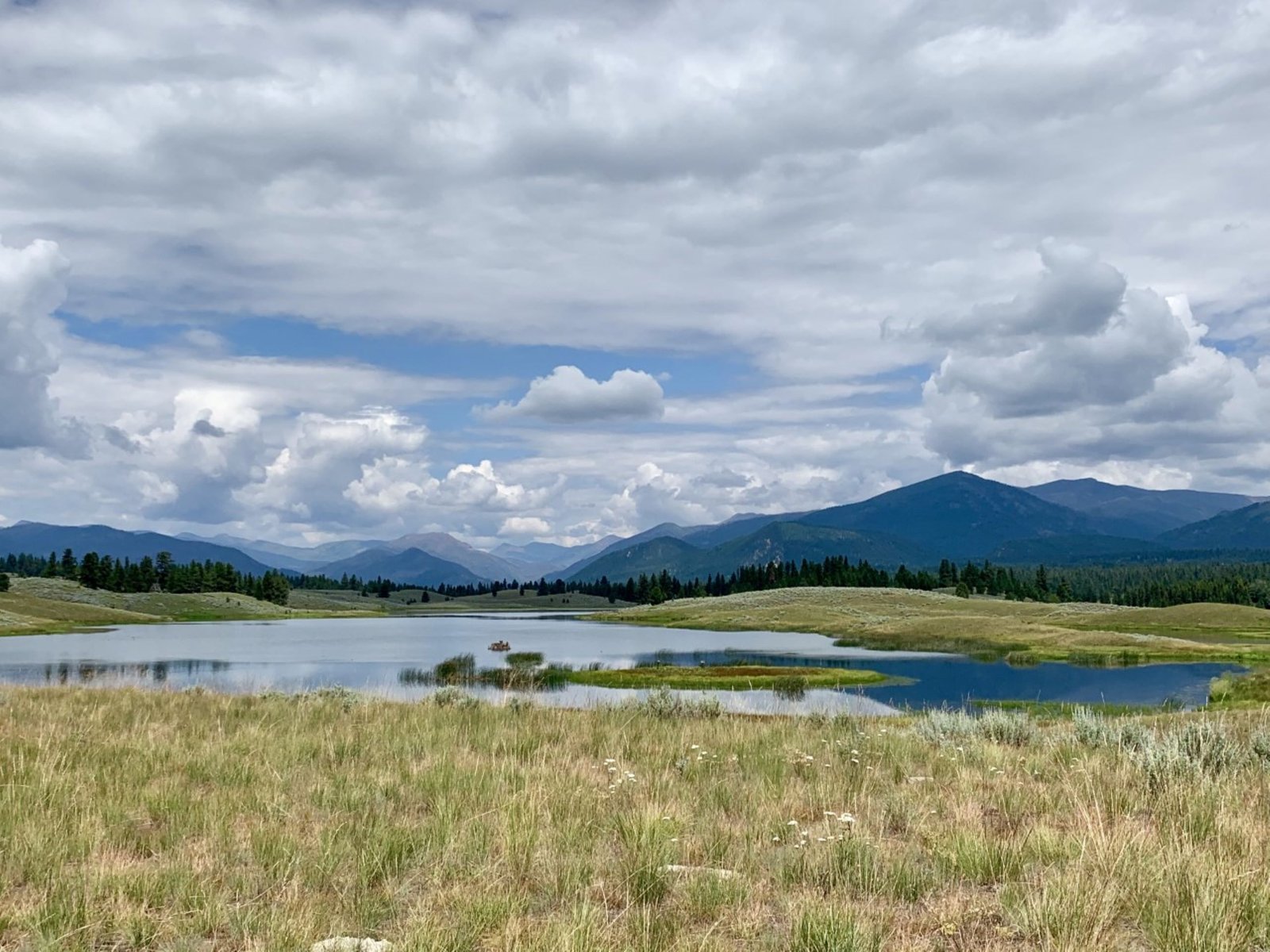
Featured photograph: Montana lake and mountains by Aubin Douglas/USFWS, public domain. Representative scenery; the photograph does not establish hunting access. Photo source checked September 11, 2026.